The People's Orchestra and Show Choir Podcast · Season 1, Episode 4
The People's Orchestra and The People's Show Choir Podcast, April 2025: Inside The People's Orchestra
Released 1 April 2025 · 20 minutes · Hosted by Matt Ward
Prefer to listen? Play the audio here, or listen on Acast.
🎵 Chapters
Jump straight to the part you want. Click any timestamp to play the video from that point.
🎧 About this episode
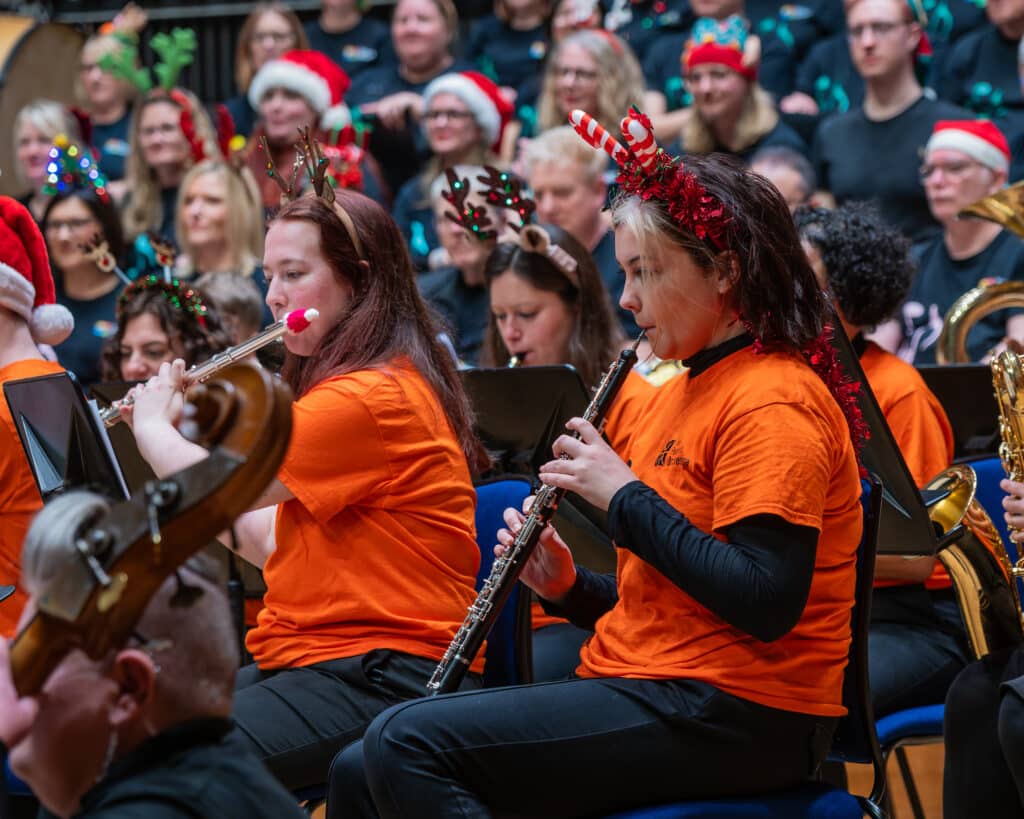
Matt Ward talks to first violinist and orchestra leader Mandy Toor, trustee and Rusty Players conductor Julian Powell, and Annie Routley, who has played viola with The People’s Orchestra since its first rehearsal in 2012.
Episode details
- Released
- 1 April 2025
- Length
- 20 minutes
- Host
- Matt Ward
- Series
- The People's Orchestra and Show Choir Podcast
Questions answered in this episode
❤️ Get involved
Try The People's Show Choirs, The People's Orchestra or the Big Band – your first two sessions are free. Every membership funds our work supporting people into employment and through financial crisis.
Full transcript
This transcript was made from the episode’s captions and lightly edited for readability. Click any timestamp to play the video from that point.
Intro (0:00)
[Music]
0:05 Matt Ward: Hi, I’m Matt Ward, and this is The People’s Orchestra and Show Choir Podcast. As usual, we will be informing you about what’s happening now, and looking into the future at what’s coming up for The People’s Orchestra and The People’s Show Choir. This month I catch up with Julian Powell from the board of trustees to discuss his work and role; I chat with Mandy Toor, our talented first violinist and orchestra leader; and I speak with Annie Routley, who’s been part of The People’s Orchestra since its very first rehearsal, 14 years ago. Before we get into this month’s packed programme, though, let’s go over to Chris for April’s Word of the Month.
Musical Word of the Month: sforzando (0:38)
[Music]
0:42 Chris Weber: The word of the month is sforzando. It is an indication to make a strong, sudden accent on a note or chord. Sforzando literally means subito forzando, which translates to “suddenly with force”. The effect of a sforzando may be interpreted and explained in terms of both dynamics and articulation. Sforzando can be written as a note accent, which appears in sheet music as an upside-down V symbol, or simply with the letters sfz above or below the note.
[Music]
Mandy Toor, first violinist and TPO leader (1:21)
1:21 Matt: Thanks, Chris. Joining us now is someone who plays a truly vital role in bringing our orchestra together: our fantastic first violin and leader, Mandy Toor. As the musical bridge between conductor and players, Mandy not only helps shape our sound, but also brings a wonderful sense of passion and positivity to the group. Hi, Mandy – how’s your day going so far?
1:42 Mandy Toor: Good morning! The day is going very well so far. I feel awake and ready for this – I’ve just done an 8am violin club at one of the primary schools in Sandwell.
1:52 Matt: Well, thanks for joining us. So, as leader of the orchestra, how do you inspire and bring out the best in your fellow musicians?
1:58 Mandy: Ooh, OK. I feel it would be very selfish of me to say that I single-handedly do this. I feel our group is very fortunate to have so many positive people within it. For example, if we’ve got any new members starting in our orchestra – I happen to be quite the social butterfly, so I do like to think of myself as quite welcoming, and ready to talk to whoever’s coming through the doors. I think, as a general rule, everybody talks to everybody. And we like to celebrate things that go right. So if someone’s just shredded an absolute beast of an area in a piece, it is the type of group that will clap something that has gone very, very well. So I think we’re all very much about building each other up, celebrating the positives, and just generally being very welcoming.
2:55 Matt: Well, that sounds like a lovely environment. How has being part of this ensemble helped you grow as a musician and as a person?
3:02 Mandy: Well, I’ve been playing since I was six, so I’ve gone through the systems of growing up within the local borough music service – I was in Sandwell Music Service. I then studied music throughout college, and then went to conservatoire. So I’ve always known music; music has always been something I’ve been really interested in. I went to Leeds Conservatoire, so I moved up to Leeds, but I always knew I was coming back to the West Midlands. I finished doing all my university ensembles, where I led the orchestra and was part of quartets and duos and all this sort of business, and when I came back to the Midlands I was a bit like, “oh, I’d really like an ensemble to play in”.
3:59 Our music service used to always play in West Brom Town Hall, so I had a bit of a research, as you do, into bands and orchestras that were around. And I fancied something a bit different as well, because I’ve always had the classical background – and I still am, to this day, in multiple different groups playing multiple different things. About a month ago I played Beethoven’s Fifth Symphony, as well as Haydn’s Trumpet Concerto, in another group that I’m part of. However, the reason I got drawn to TPO was because the music that we play isn’t the standard repertoire that you’d play in, say, Birmingham Philharmonic. As much respect and love as I have for groups like that, I already have my fill of standard classical repertoire. So when I saw that The People’s Orchestra offered avenues that specialise in film music, game music, TV music – it’s just something a bit different, and it really, really appealed to me.
5:00 So I thought: oh, it’s an orchestra that not only rehearses in an area that I’m familiar with, but does concerts at West Brom Town Hall, where I grew up doing concerts with the music service. There was that sense of home, that sense of familiarity. In a weird way, it just felt like coming home. Even though I didn’t know anybody in the group at the time, it was just a case of: it felt right. And as soon as I came, I instantly made connections with other people. I think our cellist, Kerry, joined pretty much at the same time as me. Skip forward to the current day, and there are people I was in Sandwell Music Service with who have also joined. So it’s kind of collated into an essence of family, as such. You come to these rehearsals and make friends with the people you see every week, but then you’ve also got the nice familiarity of people you used to play with back in the day who have now joined as well.
6:00 Matt: It sounds like you came for the music but stayed for the people.
6:03 Mandy: Absolutely – and it’s a double whammy, a bonus, isn’t it? It’s music that I think appeals to the non-musicians out there more so. Speaking from my own personal experience, when I’m playing in schools, doing live music weeks or demo days, and you think about the music you’re playing to the children – as important as it is to bash out a bit of Vivaldi’s Four Seasons and a bit of the classical repertoire, the music that excites them is when you play the Harry Potters, and the music that children are inspired by, in an orchestral style.
6:53 Matt: That’s it.
6:55 Mandy: That’s it. And they don’t think about it when they’re watching these films. I’ve got a bit of a beef with this, actually, because Harry Potter came out when I would have been in Year 5 – I’m 33 now. So when I go into schools and I see people are still Potter-mad to this day, I think it’s absolutely incredible – it’s such a phenomenon that these kids are still so passionate about a franchise that started when I was in primary school, which is sad to think was quite a few years ago now!
7:28 Matt: But it’s great to see you haven’t lost your passion!
7:30 Mandy: That’s it. They’re saying, “oh, Harry Potter‘s my thing”, and I’m like, “hold on – Harry Potter‘s my thing!” But in the grand scheme of things, Harry Potter is our thing, so we’ve got that to bounce off between us.
7:48 Matt: So what advice would you give to somebody who might feel nervous about joining an orchestra for the first time, but wants to get involved?
7:55 Mandy: I’d say: put those nerves at ease. Get your instrument, and get yourself down to a rehearsal. We’ve got two fantastic groups for you to join. If you’re confident and you feel ready for these rehearsals, come and join The People’s Orchestra – particularly if you’re a string player. If you’re Grade 5 and you’re ready, we’re here for you. If you’re not so confident with your sight-reading and you feel like you need a bit of an ease into it, by all means come and join the Rusties, where it’s a bit more of a slower pace and an easier environment, musically. Either way, there are groups ready for you to join. Come and join us!
8:38 Matt: Excellent – that sounds like great fun. Thank you for taking the time to talk to us today, Mandy.
8:42 Mandy: No problem at all.
8:44 Matt: So if you’d like to give The People’s Orchestra a try, rehearsals are on Sunday evenings at Trefoil House in Birmingham, between 4 and 7pm. But if you haven’t played in a while, or don’t have confidence in your sight-reading, then the Rusty Players Orchestra is the perfect place for you, with four locations: Barry Island, the Black Country, Caerphilly (name unconfirmed) and South Birmingham. So go to the website and click on “two weeks free”.
Julian Powell, Rusties conductor and board member (9:11)
9:11 Matt: Now, Julian Powell is on the board of trustees for The People’s Orchestra, and he’s also the conductor of the Rusties Orchestra, and percussionist for both The People’s Orchestra and The People’s Big Band – and he joins me here today. Hello, Julian!
9:25 Julian Powell: Hi there – how are you doing, Matt?
9:27 Matt: Very, very good, thank you. So, you’re absolutely immersed in the charity. Tell me how you got involved.
9:32 Julian: I got involved in the charity quite a while ago – a long while ago, when it started. I filled in for other percussionists when they weren’t there for concerts and things, so I did one or two concerts back in the day.
9:44 Matt: OK. And of the different aspects – the orchestra, the Rusties and all of that – which one did you start with, how did you progress through, and how did you end up on the board?
9:55 Julian: When I started, it was just The People’s Orchestra. There were no choirs, no Rusties, nothing else – it was just about the orchestra. I filled in then, and came back a few times, and I think it was just after the pandemic, when they did the first concert, that they didn’t have a drummer. So I filled in for a few concerts then, and then they got a drummer in – who they’ve got now, Andy – and I’ve been playing percussion, along with my partner, who also plays percussion.
10:25 Matt: How is it that you first got involved in music? Have you been playing music since you were a child?
10:30 Julian: Yes – I first got into music at eight years old. My mother’s parents had moved away to America, and they’d left their piano behind with us, and they said, “hey, you’re going to have piano lessons”. So that’s how I got started. I always wanted to learn jazz, but I was told I had to learn classical, so I learned to love them both. And my brother was in a marching band, and I used to go along on Sundays – you know, free childcare! – and I wanted to play drums just like him. But then one day I saw a xylophone and thought, “wow, it’s like a piano, but it’s like a drum”. And through that I carried on. I did quite a long time in marching bands and everything, and ended up playing in bands in America, and teaching and arranging for bands all over the world – Germany, Holland.
11:30 Matt: It sounds like music’s always been a part of your life. What is it that made you choose to dedicate your love of music, and that time, to The People’s Orchestra?
11:40 Julian: Yeah, you’re right – music has always been part of my life. I’ve tried different things – educationally, going for business or sport and everything – but in the end I’d always come back to music; when things didn’t work out, I’d always come back to music. So with The People’s Orchestra, with the large range of things they’re doing, it just made a lot of sense, because I can get my classical music, and my jazz music, and a whole bunch of different styles within that one organisation.
12:15 Matt: So now you’re a member of the board of the charity. What’s your day-to-day, in terms of that role?
12:20 Julian: We have meetings from time to time, and we’ll discuss issues there, or if an issue comes up that’s very important, we’ll have an emergency meeting and discuss it there. So it’s not really a day-to-day thing; it’s more when the meetings come up, to summarise things, or if an important issue comes up. But it also gives a good connection, because I’m so involved in all of the groups – if I see something, I can raise it as well. I’m like an inside man!
12:55 Matt: Perfect. So as a member of the board, how do you approach discussions and decision-making, especially in ensuring that everybody’s voice is heard, and that you’re advocating for all members?
13:05 Julian: Well, the board is very varied. Everybody on the board covers a large spectrum: we’ve got all genders, ages, races as well, and also financial backgrounds – which makes a huge difference, because we’ve had a few decisions lately about helping to support the workers in the office, as it relates to the cost of actually getting to work, and paying for everything like that. So having that variety of people on the board really does help us make it a good discussion, as opposed to just “we think this – OK, we all agree”. If there’s anything, we can have a full discussion, really flesh out the matter, and then come to a good decision.
14:00 Matt: Thank you so much for talking to me today. It’s been an absolute pleasure spending time with you and getting to know more about you. Will you come back in a future episode and talk about the Rusties Orchestra?
14:10 Julian: Yes, I’d definitely like to talk about the Rusties, because it’s all very new to me as well – so I’m pretty rusty!
14:17 Matt: Absolutely brilliant. Thank you, Julian.
14:19 Julian: Thank you.
Annie Routley, longtime TPO member and violist (14:24)
14:24 Matt: Joining us now is someone who’s been with The People’s Orchestra since day one, in 2012. She’s seen it grow from its very first rehearsal to the incredible organisation it is today. Annie Routley is both a dedicated musician and a true part of the TPO family. Hi, Annie. You’ve been with The People’s Orchestra since the very beginning. What is it that made you join, and what is it that keeps you coming back?
14:48 Annie Routley: What made me join is the repertoire. TPO plays almost entirely big film scores, and they are so exciting to play. That’s what’s kept me coming back.
15:00 Matt: Fantastic. Now, we’re here all these years later, rehearsing for The People’s Orchestra’s biggest-ever performance, at Symphony Hall. How does that feel?
15:08 Annie: Oh, it’s wonderful. It’s an amazing hall – it’s all red and gold, and the acoustics are incredible.
15:15 Matt: What’s it been like watching new projects, like the show choirs or the big band, grow out of what was originally just an orchestra?
15:24 Annie: It’s been wonderful to see how it’s diversified. I particularly love the fact that we’ve got a Rusty Players Orchestra, which encourages people to get their instrument out of the attic and start playing again. I’ve done a number of concerts with the Rusties when they needed an extra string player. And everything the TPO organisation does is very positive and very life-affirming for people.
15:50 Matt: Yeah – I’ve got that, Annie. This is the fourth episode we’ve made of this show now, and that is really, truly a running theme. Do you feel that being part of something from the ground up has shaped your experience differently than if you’d joined later?
16:10 Annie: Yes. We started very, very small. We didn’t have enough to make an orchestra at first, so there were five flute players and me on viola doing Scott Joplin, five clarinets doing Disney tunes, and five brass doing brassy things! But eventually we had enough. Fortunately, the organisers didn’t hold out for double woodwind and desks and desks of strings. We only had two violas for the first year and no other strings, but we had 14 flutes and a dozen saxophones. So we’ve always arranged for what we’ve got, and I love the flexibility of that.
16:50 Matt: OK. So now, in 2025, we have a better balance, with more strings to match the number of flutes. And I’m sure that a larger orchestra could be quite intimidating for new members. What advice would you give to someone who’s thinking of joining, and how would you make anyone trying it out feel comfortable?
17:08 Annie: I would encourage them to join, because it’s added so much to my life, and I’d want them to be part of that. I always try and greet every new member, and tell them a bit about the history, but also how much I love it, and how much being part of TPO has added to my life.
17:30 Matt: Great. Annie, it’s been incredible hearing about your journey from the very first rehearsal to now, preparing for Symphony Hall. Your story really shows what The People’s Orchestra is all about: community, resilience, and the power of music to bring people together. Thank you for joining us.
17:45 Annie: Thank you.
17:47 Matt: If you’ve been inspired by Annie’s journey, and want to help us continue creating life-changing opportunities through music, please consider making a donation. Every contribution, big or small, helps us keep this amazing community going and growing, so that even more people can experience the magic of what Annie has been part of since day one. Go to the website, thepeoplesorchestra.com, and click on the Donate button.
[Music]
Where can I sign up? (18:15)
18:15 Matt: We are now well into spring. All of our ensembles are eagerly beginning work on an exciting new repertoire of music, in preparation for our local community concerts in the summer. We’re warming up our vocal cords and our walking boots for our second-ever People’s Show Choir tour [unclear], as the Scottish Highlands tour draws closer – the next major event in our calendar. And remember, you can march through April by joining us for one of our free walking choir events, which are listed on the website under the Events tab. If you’re not already a member, now’s the perfect time to think about joining us. Head to thepeoplesorchestra.com to find out how to sign up for two weeks free for The People’s Orchestra, one of our 20 show choirs, a Rusty Players Orchestra, or the Big Band.
Coming up in the next episode (19:05)
19:05 Matt: Thank you for listening to this episode of The People’s Orchestra and Show Choir Podcast. In next month’s episode, I’ll be talking to members about the hugely successful Mother’s Day concert, Back to the Movies, at Birmingham Symphony Hall on March the 30th. If you missed it, don’t worry – as well as our feature in next month’s podcast, you’ll be able to catch up on highlights from the concert on our YouTube channel. Check out the website, thepeoplesorchestra.com, and follow The People’s Orchestra and The People’s Show Choir social media channels. And if you would like to find out more about how I can help you with making a podcast for your organisation, take a look at my website, audioeditingsecrets.com, and follow my social media, which is @audioeditingsecrets, on Facebook, Instagram, YouTube and TikTok. I’ve been Matt Ward – thank you for listening.
[Music]
Previous episode · Season 1, Episode 3
March 2025: Come and Sing, Walking Choirs and Back to Work
Matt Ward revisits our first Come and Sing Day at Cheltenham Ladies' College with organiser Claire Lambert, and hears from Chris Weber about the free walking choirs, Mariann Harris about TPO's back-to-work support, and Julie Lawrence about the Ringers Choir.
Next episode · Season 1, Episode 5
May 2025: Our 13th Anniversary Episode
In this anniversary episode, host Matt Ward looks back at our Mother's Day concert at Birmingham Symphony Hall, and hears from choir leader and multi-instrumentalist Liz Read, office team member Paige Leung, who organised the day for 600 performers, and CEO Sarah Marshall, as The People's Orchestra turns 13 and passes 1,000 members.