The People's Orchestra and Show Choir Podcast · Season 1, Episode 5
The People's Orchestra and The People's Show Choir Podcast, May 2025: Our 13th Anniversary Episode
Released 8 May 2025 · 34 minutes · Hosted by Matt Ward
Prefer to listen? Play the audio here, or listen on Acast.
🎵 Chapters
Jump straight to the part you want. Click any timestamp to play the video from that point.
- 0:00 Intro with a special thank you
- 0:50 Lookback montage of Symphony Hall
- 4:51 Musical Word of the Month: andante
- 5:31 Liz Read, choir leader, flautist and saxophonist
- 15:18 Paige Leung on Symphony Hall
- 21:44 CEO Sarah Marshall on TPO's anniversary
- 28:40 Choir members' messages to Sarah
- 30:31 Sarah's reaction and final words
- 32:03 Coming up across May
- 32:34 Where can I sign up or donate?
- 33:02 Special message
- 33:18 Coming up in June's episode
🎧 About this episode
In this anniversary episode, host Matt Ward looks back at our Mother’s Day concert at Birmingham Symphony Hall, and hears from choir leader and multi-instrumentalist Liz Read, office team member Paige Leung, who organised the day for 600 performers, and CEO Sarah Marshall, as The People’s Orchestra turns 13 and passes 1,000 members.
We also hear community engagement manager Chris Weber’s address from the Symphony Hall stage, and voice messages from choir members about what TPO means to them.
Episode details
- Released
- 8 May 2025
- Length
- 34 minutes
- Host
- Matt Ward
- Series
- The People's Orchestra and Show Choir Podcast
Questions answered in this episode
❤️ Get involved
Try The People's Show Choirs, The People's Orchestra or the Big Band – your first two sessions are free. Every membership funds our work supporting people into employment and through financial crisis.
Full transcript
This transcript was made from the episode’s captions and lightly edited for readability. Click any timestamp to play the video from that point.
Intro with a special thank you (0:00)
[Theme song]
0:12 Matt Ward: Ladies and gentlemen, welcome to a very special anniversary edition of The People’s Orchestra and Show Choir Podcast. Today we celebrate more than just a milestone. We honour the stories, the gratitude and the love shared by over 1,000 incredible members who make this community what it is: a family. A force. A reminder that music, when shared with heart and purpose, has the power to connect us in extraordinary ways. Thank you for being part of this journey – for showing up, singing out and making space for one another in every note. This episode is for you.
Lookback montage of Symphony Hall (0:50)
0:50 Matt: To kick off this month, let’s look back at the Mother’s Day concert at Symphony Hall, with the introduction speech from Chris Weber, accompanied by a montage of music from the day.
1:07 Chris Weber: My name is Chris Weber, and I have the privilege of being the community engagement manager for The People’s Orchestra. I’m going to tell you a little bit about this incredible organisation. But before I do, I’d also like to wish all the mothers here a happy Mother’s Day – and I don’t just mean the biological mothers, but anyone who’s been a mother figure to someone and has helped shape their life through their care and boundless love. So thank you. So let’s just give all the mothers and mother figures in the room…
[Applause]
1:38 The People’s Orchestra and The People’s Show Choirs are unlike any other similar organisations. Many choirs and orchestras raise money for various charities – but we are the charity. Our Queen’s Award-winning non-profit organisation supports some of the most vulnerable in our communities: people with no access to the disability benefits they desperately need, and people who are struggling to get into employment.
2:01 There are two teams of people that work for TPO. Firstly, the staff that are visible to all our members. These amazing people, most of whom are present here today, manage and administrate the six orchestral ensembles, twenty choral ensembles and three walking choirs that are dotted across the UK. And we also have a second team, who are on the front line of the charitable work in our local communities. They are the unsung heroes who make our purpose for being here happen.
2:27 Thirteen years ago, the orchestra played its first-ever few bars of music at the Adrian Boult Hall. Since then, we’ve helped over two thousand people into paid work – empowering individuals, uplifting families and strengthening communities. Last year alone, families in crisis were £150,000 better off because they came to us when no one else could help. This is proof that music can make a real difference.
2:59 We now have over a thousand members, whose membership fees go entirely towards the work I’ve just mentioned – and you can be part of it too. There are so many ways to support our work and help us to reach even more people in need. You can play an instrument – join The People’s Orchestra, The People’s Big Band, or one of our Rusty Players Orchestras – and use the joy of making music to spark real change. If singing is your thing, we’d love to welcome you to one of our choirs across the UK. Not musical? No problem – you can still make a significant impact. Share our posts on Facebook or Instagram to help us spread the word. Make a donation, leave a legacy, or even offer a few hours of your time. From marketing and website support to graphic design, or simply helping us staple sheet music, every contribution counts. Together, we can amplify voices, transform lives, and prove that music truly matters. So thank you for being here. Thank you for listening. Thank you.
[Applause]
[Music: “What a Wonderful World”, from the concert]
4:23 Matt: What a wonderful world indeed – and what a wonderful message. How am I going to follow that? Oh, go on then, I’ll tell you. This month I chat with People’s Orchestra all-rounder Liz Read, find out about the organisation of Symphony Hall from Paige Leung, and speak with our CEO, Sarah Marshall, as The People’s Orchestra and Show Choirs organisation marks its 13th year. Before we get into this month’s packed programme, let’s go back to Chris for May’s Word of the Month.
Musical Word of the Month: andante (4:51)
4:51 Chris: The word of the month is andante. It is a term that means moderately slow, or at a walking pace. It’s a tempo marking used to indicate that a piece should be played neither too fast nor too slow, but at a moderate, steady pace. When a composition is marked andante, it invites the musician to adopt a tempo that is calm and flowing, often imbued with a sense of tranquillity and thoughtful expression. Other words often used to describe andante include steady, even-paced, easy-going, measured and lyrical.
Liz Read, choir leader, flautist and saxophonist (5:31)
5:31 Matt: Thanks again, Chris. From conductor to multi-instrumentalist and even vocalist, Liz Read is a true powerhouse within The People’s Orchestra. She first joined in 2017 as a flautist in the orchestra, became orchestra manager in 2019, and moved on to become the conductor of the South Birmingham Choir in 2020. But her passion and dedication quickly saw her take on even more – she now also leads the Bearwood and Dorridge choirs. When she’s not conducting, you’ll find her playing flute in The People’s Orchestra, switching to saxophone for The People’s Big Band, and even stepping up as a singer for performances. With such a wide-ranging role across the organisation, Liz is the definition of musical versatility. Hi, Liz!
6:21 Liz Read: Hello!
6:23 Matt: So, you’re involved in so many areas of The People’s Orchestra – running multiple choirs, playing flute in the orchestra and saxophone in the big band. What is it about TPO that keeps you enthusiastic and engaged?
6:35 Liz: I think partly the range of things on offer. Like your introduction said, it’s grown over time. I joined initially as a flautist, and then I ended up working for TPO as orchestra manager and got involved that way. And then as the choirs took off, I began conducting the choirs, and when the big band started, I played my saxophone in the big band. I’ve always played flute and saxophone, from quite a young age, and just having all of that on offer within one organisation really helps, I think. So – a one-stop shop for everything!
7:13 Matt: So how did you first get involved with TPO, and did you ever imagine you’d end up wearing so many hats?
7:18 Liz: No, not when I first joined. It was purely for pleasure, and to get back into playing my flute. I had done a degree in music, with flute as my main instrument, and had ended up working as a primary school teacher, and therefore not having much time for music any more. I was really keen to find somewhere to play my flute again and get back into music-making, and TPO offered that. So I went along just as a hobby to start with. Over time – I’d always kind of wanted to specialise in music teaching anyway, at some point – in 2019, when I was looking to go freelance as a music specialist, TPO also needed an orchestra manager, and it all just kind of fell into place. And the more I get to know them, the more things they’ve added – the big band’s probably one of the more recent ones.
8:10 Matt: So what do you love most about leading the Bearwood, Dorridge and South Birmingham choirs? How do they each bring something different to your experience?
8:18 Liz: I think being a choir leader is one of the most fun job roles that I do. You’re essentially bringing a bit of joy into people’s week. They come along, you do a load of singing, and hopefully they go home feeling a bit better than when they walked in the door at the start of rehearsal. There is something really special about singing together in a group – it’s not just about the musical outcomes. Obviously we want to have good musical outcomes, but also the sense of community across the choirs, and the friendships that you see being built. It’s a really rewarding job role.
9:00 As for the three different choirs that I run, they all have their own personality, which I really like. So it’s different, even though we’re doing the same music in each one of them most of the time. The personalities, and the different musical experiences that the members bring, do vary the way in which I might have to approach teaching different songs, and things like that. So it’s never just the same – whichever choir you go to, they are all slightly different.
9:34 Matt: And do you think you have much influence over the personality of each individual choir yourself?
9:40 Liz: Potentially. I guess when people come through the door and decide to stay, they stay because they like the environment they’re in, and it’s the choir leader’s role to set up that environment. I like to think that I make it as inclusive as possible, so that everyone feels welcome. And I tend to find most of the members are really welcoming to new people, and just want people to stay, and are very kind and generous people. So it’s a nice environment.
10:10 Matt: Aw, that sounds lovely. So with the orchestra, switching between flute, and sax in the big band, must be quite a shift. How do you balance the different styles of playing, and do you have a favourite?
10:20 Liz: It’s something I’ve just always done, to be honest – I’ve never really thought about it that much! When I was younger I was learning the flute, and then in my teenage years I was desperate to join the school jazz band and soul bands and all the really cool groups. My flute teacher happened to also be a saxophone teacher, so I switched lessons at that point. I still carried on playing my flute in other groups – orchestras and wind bands – and added saxophone at that point. So it’s just something I’ve always done. I enjoy it – I like variety.
11:00 Matt: Can you share a favourite People’s Orchestra memory – maybe a performance or a moment that really stands out?
11:05 Liz: There are a few. If I go in timeline order, the first big thing that I took part in was an exchange with a Canadian orchestra. We actually got to travel all the way over to Montreal and play with their orchestra, and then they came here a year later – or it might have been the other way around? It all blurs into one! I think they came here first, actually. But they came here and we went there, and it was all a lot of fun. And it was a different set-up, different styles of music, so we all learned quite a lot from each other. They had a more traditional classical set-up, and we have more of a community set-up – we play a lot more film music and more modern stuff. So it was nice to experience a bit of both, and meet lots of new people.
12:05 Then, in more recent times, we keep growing and growing with all the choirs, and the highlight of the year really is the Christmas concert, where all the choirs come together and the orchestra accompanies them. The first time we went to Birmingham Town Hall – I’m trying to remember if it’s two or three years ago now; I think we’ve done two there – the sheer size of it… sitting in the orchestra, right in the middle, and hearing 290 singers around me singing the songs we’d been learning in rehearsals, with maybe 20 or 25 of them at that point in my biggest choir – it showed the scale of what we were doing now, as opposed to a couple of years previously, when it was just The People’s Orchestra, no choirs, at West Bromwich Town Hall, still doing lovely concerts. The scale of it changed.
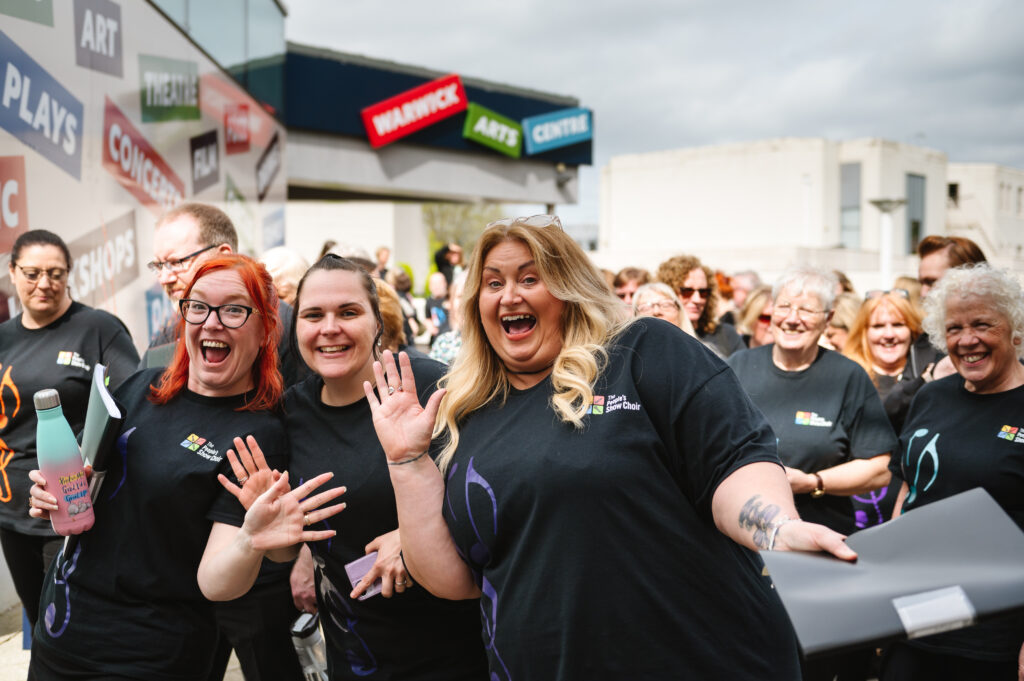
13:05 And then, right up to just a couple of weeks ago, on the 30th of March, we had our Back to the Movies concert on Mother’s Day at Symphony Hall. To have made it to Symphony Hall – again, I just sat there and thought, “wow – this is little us, and here we are in one of the best concert halls in the country!”
13:30 Matt: Yeah – not so little you now!
13:32 Liz: No!
13:33 Matt: On that note, what would you say to anybody who was thinking about joining the orchestra or a choir in any capacity? What would you say to encourage them?
13:40 Liz: Just come along and give it a go. There are so many orchestras that you can definitely find the right fit. Within the Midlands, anyway – they’re more spread out elsewhere – there’s the main People’s Orchestra, for which there is a certain standard you need to be; they tend to say Grade 7 and above. So if you’re really serious about your instrument and have lots of experience, that might be the one for you. But there’s also the Rusty Players Orchestra, which is what it says on the tin: rusty players – maybe you haven’t played for a while, or maybe you’re newer to playing your instrument – and it’s a more relaxed environment, with less difficult pieces, basically. And then there are the big bands, and then there are the choirs. So there’s all sorts of stuff you can get involved in to find your place. And there’s always a two-week free trial, so you literally have nothing to lose. Just go along, give it a go, see if you like it – and then you’ll probably want to stay!
14:35 Matt: Brilliant. Thanks so much for taking the time to chat to us, Liz.
14:40 Liz: No worries – thank you for having me.
14:45 Matt: So if you’re feeling inspired by Liz’s journey – whether you want to sing, play, conduct, or even try something new – there are so many ways to be part of The People’s Orchestra. From choirs to big band, orchestral playing to behind-the-scenes support, there’s a place for you in our musical community. Get involved today and find your own way to make music with us by visiting thepeoplesorchestra.com and clicking the “two weeks free” button, or drop us an email at hello@thepeoplesorchestra.com.
Paige Leung on Symphony Hall (15:18)
15:18 Matt: We’re now really fortunate to be joined by one of our office staff, Paige Leung, who was instrumental in the entire organisation of our Symphony Hall concert. So, Paige – hi!
15:28 Paige Leung: Hello!
15:30 Matt: We’d love for you to give us an insight into what it takes to put something of that scale together. How far in advance do you start working on it, and were there any major hurdles along the way?
15:40 Paige: Well, actually, booking the venue would be the first point of the concert, and that could go way back – a year or two years ahead – for the really important dates, like Christmas. For this one, I think we started a year ahead of the actual concert date. From that point, the team would come up with the idea – the theme of the concert, and the music to perform at the concert, and which ensembles or choir locations would be performing at a particular concert. Many of these have to be decided as early as possible, as they inform the decisions on things like licensing of the music, and also setting timelines for our members.
16:25 The major hurdle, I think, is that sometimes things may not turn around as quickly as we’d like them to. As much as we’d like to get things prepared and sorted earlier, before the actual event, there are always some last-minute changes that happen. Even things that might sound trivial might actually lead us to need to rework the timings of the day – for example, if we could only get access to the green rooms at a later time, or the arrival times of coaches for our members travelling from out of the area, which would be affected by the traffic, which we couldn’t really control. Those would have to be taken into account when modifying the rehearsal and break timings before the concert.
17:05 Matt: OK – it sounds like it doesn’t matter how far in advance you start planning, it always goes right up to the wire!
17:10 Paige: Yeah. We always want to keep it in advance – it would be ideal to plan everything ahead, as opposed to something coming up spontaneously.
17:21 Matt: So how did the logistics of a venue the size of Symphony Hall compare to other concerts that TPO have organised? What’s different?
17:30 Paige: Well, the event day itself was long, but when you have a lot of items and tasks to sort out throughout the day, all the timings are really tight. Even though we asked our members to arrive about six hours before the actual concert started, it was more tricky for a venue the size of Symphony Hall, and with the number of performers we had on the day – it basically means that even with people arriving early, we had to squeeze the timing and schedule even more, to leave time for everyone to move around the venue between rehearsals and the concert, going onto and leaving the performance areas and the stage. And also, because of the size of the venue and the number of performers we had, we needed to find sufficient spaces to accommodate everyone with their belongings, and make sure everyone knew where they should go throughout the day without getting lost in the massive venue.
18:35 Matt: And it sounds like it was a long day as well. I hear that you and the rest of the staff were there from 7:30am. What was it like organising 600 people on the day?
18:48 Paige: Yeah, it was 7:30am for us, but with all the tasks and logistics to sort out on the day, a long day sometimes still feels like it’s passing really quickly. When you’d just finished setting up the stage and putting up signage backstage, you could hear on the radio that members were on their way to registration, and it felt like suddenly the rehearsals and the concert itself were happening. But we were very lucky to have volunteers from our choirs and orchestra supporting our small office team on the day, guiding performers from arrival to rehearsals to the concert. They were so supportive and helpful all the time. Having so many performers on the day also meant it was quite difficult for the office team to meet every single one of our choir and orchestra members individually, so we were really glad that we got some extra help from the groups themselves to support us and take care of everyone, making sure no one was left out at the concert.
19:50 Matt: Yeah – it’s worth mentioning here, I think, just how essential those volunteers are to a day like that, isn’t it?
19:55 Paige: Yes, that’s true.
19:57 Matt: And then, once it’s all done, and you actually see the concert come together – how satisfying is that?
20:05 Paige: It’s really satisfying. Before the concert, things were more here and there – bits and pieces of information and tasks – so you could only imagine what it would be like for a large-scale concert like this, and how performers and audience would feel about it. So when you were actually there, seeing the concert, seeing the audience applaud and cheer for our singers and musicians – that was wonderful. And it also gave you a sense of being part of a really big group. You asked about the very long day for the staff, but actually some of our members were travelling from locations including Newport, Weston-super-Mare, Brackley and more, and may have had to get up even earlier, to catch the coaches at 5:30 in the morning. So we really appreciated the efforts and dedication our choirs and orchestra put in to make the concert a big success, which we are really proud of – and they should be really proud of themselves as well. And I believe they were surely enjoying the concert, with all the smiling faces and laughter, and the amazing performance they gave us on the day. So it was a really good feeling.
21:20 Matt: Well, hearing about it, you’ve put a smile on my face, Paige – so thank you for talking to us today.
21:25 Paige: Thank you, Matt.
21:27 Matt: And remember, as Paige mentioned there, a day like Symphony Hall couldn’t be a success without the help of volunteers. So if you have a special skill, or just time to help out, get in touch at thepeoplesorchestra.com, or by sending us an email at hello@thepeoplesorchestra.com.
CEO Sarah Marshall on TPO’s anniversary (21:44)
21:45 Matt: In our first podcast, we spoke to Sarah Marshall, the CEO of The People’s Orchestra, and I’m now delighted to say she’s back with us. Hello, Sarah – how are you?
21:52 Sarah Marshall: Hello, Matt – lovely to speak to you again.
21:55 Matt: Yeah, you too. Now, last month marked TPO’s 13th birthday. As your baby has now become a teenager, what’s that journey been like for you?
22:05 Sarah: Oh, wow – time flies. It’s been a rollercoaster, to be fair. There have been some fantastic highs, and there have been some lows along the way. We can’t say it’s been a smooth journey – it definitely hasn’t. But it’s been great to see how it’s evolved, and it’s been great to meet so many people along the way.
22:30 Matt: Fantastic. So is there a target for the future for you, or is this work all about the journey?
22:35 Sarah: I was thinking about this – where is it we actually want to go to? And no, I don’t think there’s a target. I think it’s more that if there are people who want to sing, and people who want to make music with us, that’s what we’re going to do. We’re going to keep going. I’d love to see how this organisation changes over time. I’d love to say we’ll be going for a target of sustainability in the future, and not being reliant on grant funding as we are now. Maybe that’s a pipe dream in a way, but we will keep heading for that. I would love to see more people come and experience TPO, the orchestras and choirs – that would be great. Come and sit in the audience, come and listen to what we do. And I think the target is just to make more and more great music.
23:34 Matt: Yeah – well, you’ve certainly been doing that, from what I’ve been hearing. We’ve recently also hit another huge milestone, which is the 1,000-member mark. How does that make you feel, and what impact does a membership that size have on the charitable work that can be done?
23:48 Sarah: Symphony Hall was great – there’s no doubt about it. I was in a very privileged position behind the scenes, able to go and be nosy, and having that many people there, and seeing how they all interact – the participants are fantastic. The singers and the musicians, amazingly talented people, coming together to make some great music. But it’s being able to see those interactions – how people are helping each other; people that are less able being helped by other members of their choirs; how people really go out of their way to be supportive – that has just been absolutely amazing. And then to get to hear the final result of what the choir leaders have been doing each week, and what Saph has been doing with the orchestra each week, all coming together – the sound in Symphony Hall is absolutely amazing when the orchestra and choir go together. Sometimes the YouTube videos don’t get that across as well as when you’re in the audience.
25:00 But I think one of the biggest things about the day was how the staff came together to put on such a massive event. Every time we step up in venue size, it brings with it a whole range of new issues and problems we’ve got to deal with. And to have such a small staff, and quite a young staff, able to come together and put that on, and make it go so smoothly for so many people on that stage – and then for us to be able to look back at it with some fantastic videos and fantastic memories… The staff did amazingly – absolutely amazingly. Every time we go to one of these events, I’m just stunned at how they manage to do it. So from a privileged point of view, being the CEO, I get to see all the good bits at the back that maybe the audience don’t get to see.
25:58 Matt: Great. And I asked you about the charity work there…
26:00 Sarah: Our charitable work is amazing as well! I think sometimes we don’t shout about that quite as much. Annually, at the moment, our orchestras coming together to play, and our choirs coming together to sing, are bringing in the region of £150,000 a year to families in crisis – to some people who really desperately need help and have nowhere else to go. People who’ve tried to go to other agencies that, from the outside, maybe look more suited to doing that, but who haven’t had the right information. And we have a 100% success rate in supporting people with benefits and advice.
26:53 And to know how much that makes such a difference to the people in the communities that we’re in – the communities that listen to our music, but not necessarily the musicians and the singers themselves all the time. It’s about the other people – the people who just need a little bit of a leg up. It proves that culture and music-making can make a massive difference in the community. We’re so much more trusted, I think, in a way, than some organisations, and people will come and tell us things they won’t tell anybody else, and we can help them from that point. So it’s just amazing – how much joy and enthusiasm the singers and musicians create, and then being able to pass that on to people who really need some support at really vulnerable times of their lives, and make those changes. It’s brilliant.
27:50 Matt: I’m not sure whether I said this to you last time, but I’ve certainly thought it: what you’ve set up is a win-win-win scenario. You’ve started employing people in the charity; you’ve got the necessary work, and the value that people find from the charitable work you do, helping them with the things you were just mentioning – the benefits work and all of that; but also, what you have set up benefits your members. I feel like they get the support they need from what you’ve created. It’s been great chatting to you again, and thank you for all the hard work you put in.
Choir members’ messages to Sarah (28:40)
28:40 Matt: And we’ve actually put together a little montage of choir members telling you what the choir means to them.
28:45 Sue: Hello Sarah. I’m proud to say I’ve been a member of the choir from the very start. At that first rehearsal in Birmingham, I thought I’d just give it a try, but I never expected it to become such an important part of my life. I look forward to every rehearsal. Happy times are made happier, and on sadder days I leave uplifted. I’ve made some wonderful friends through the choir. Thank you, Sarah, for all you do – and may the choir continue to grow for years to come.
29:15 Frances: Hi Sarah, Frances here from Brackley Choir – not quite a founding member, but nearly one. I don’t know where your vision for the orchestras and choirs came from, but you have created a phenomenon. Singing in Symphony Hall in the mass choir was a feeling beyond description, and the sound was amazing. But it’s not just about the music – it’s everything else as well: the organisation, the technical team, and the attitude of “can do”, all done with fun. Over the last eight years I’ve had some very dark times, and I can honestly say that the choir was one of the very few candles I had in those times, giving me something to enjoy and positive targets to aim for. What can I say but thank you.
29:50 “What impact has being in the choir had on me? It’s given me joy. It’s given me friendship. It’s given me laughter. It’s given me a new focus since retirement. It’s given me the confidence to sing out loud – sing like no one is watching. A feeling of singing in a community, a family. Thank you, Sarah, for all your hard work. You are changing lives, including mine. Big well done, and happy 13 years of your wonderful organisation!”
Sarah’s reaction and final words (30:31)
30:31 Sarah: Wow. That was lovely to hear – it really is lovely to hear! And the one surprising thing to me in all of this is just how much support our groups give to each other on a day-by-day basis. The way our organisation works is that those networks are always there, 24/7, and people tap into them – sometimes physically, sometimes online – and it makes an amazing difference. And I couldn’t do this without the support of the amazing staff here. But it just proves that a bit of fun, a bit of enjoyment, makes a really big difference.
31:15 Matt: It really does. I’ve been hearing messages and testimonials like that since I’ve been doing this podcast – we’re on the fifth episode now – and it’s been an absolutely beautiful thing to be working on. So thank you for that. Thanks so much for taking the time to talk to us again, Sarah. I look forward to speaking to you again soon.
31:40 Sarah: Cheers, Matt – thanks ever so much.
31:42 Matt: And remember, alongside all the fun we have playing and singing, there is the serious work that we do as a charity. So if you can afford to make a small donation, please head to thepeoplesorchestra.com, click the Donate button in the top menu, and give what you can. Thank you.
Coming up across May (32:03)
32:03 Matt: Coming up in May: our summer tour to the Scottish Highlands is fast approaching. Until now, our orchestra and each of our choirs have been learning the music separately, but on Saturday the 17th of May, these elements will come together in Birmingham’s Chamberlain Square for a five-hour rehearsal, to bring everything into harmony ahead of our journey to Inverness on May the 24th. Meanwhile, our individual choirs and orchestras are also busy preparing for their local July concerts. If you’d like to attend one, simply visit us on Eventbrite to find the dates and locations of performances near you.
Where can I sign up or donate? (32:34)
32:32 Matt: If you’ve ever thought about joining us, now’s the perfect time. Head to thepeoplesorchestra.com to find out how to sign up for two weeks free for The People’s Orchestra, one of our twenty show choirs, four Rusty Players Orchestras or the Big Band. Thank you for listening to this episode of The People’s Orchestra and Show Choir Podcast.
Special message (33:02)
33:02 Matt: Before I go, I’d like to give a shout-out to someone who’s been through a lot recently. She’s not just integral to this podcast – she’s essential. So we would love to get her back and fighting fit for next month’s episode. Get well soon, Piña Colada Girl!
Coming up in June’s episode (33:18)
33:18 Matt: In next month’s episode, I’ll be speaking with Chris Weber, who led the tour to Scotland, to find out what it took to organise such a huge event and how it all went. I’ll also be catching up with show regular Lorna Parkhouse, who has recently taken over the running of our Wolverhampton choir. And finally, I’ll be chatting with Matthew Whitehouse, our librarian, whose job it is to make sure that all 1,000 of our members get their music. Visit our website, thepeoplesorchestra.com, and follow The People’s Orchestra and The People’s Show Choir social media channels. And if you would like to find out more about how I can help you with making a podcast for your organisation, take a look at my website, audioeditingsecrets.com, and follow my social media, which is @audioeditingsecrets, on Facebook, Instagram, YouTube and TikTok. I’ve been Matt Ward – thank you for listening.
[Theme song]
Previous episode · Season 1, Episode 4
April 2025: Inside The People's Orchestra
Matt Ward talks to first violinist and orchestra leader Mandy Toor, trustee and Rusty Players conductor Julian Powell, and Annie Routley, who has played viola with The People's Orchestra since its first rehearsal in 2012.
Next episode · Season 1, Episode 6
July 2025: The Scottish Highlands Tour
Chris Weber goes behind the scenes of planning our Scottish Highlands tour, and librarian Matthew Whitehouse explains what it takes to get music to over 1,000 members, with music from the tour and our first Little Notes from the Heart.