
The People's Orchestra and Show Choir Podcast · Season 1, Episode 3
The People's Orchestra and The People's Show Choir Podcast, March 2025: Come and Sing, Walking Choirs and Back to Work
Released 28 February 2025 · 23 minutes · Hosted by Matt Ward
Prefer to listen? Play the audio here, or listen on Acast.
🎵 Chapters
Jump straight to the part you want. Click any timestamp to play the video from that point.
- 0:00 Intro
- 0:38 Musical Word of the Month: accelerando
- 1:25 Claire Lambert on the Come and Sing Day at Cheltenham
- 3:57 Speaking to the Come and Sing Day attendees
- 5:08 Choir leaders Georgie Lees and Mark Aitchinson
- 6:05 Where and how to join our ensembles
- 6:48 Chris Weber on Come and Sing and the Walking Choirs
- 11:44 Mariann Harris on TPO's back-to-work support
- 19:04 Julie Lawrence on the Ringers Choir
- 21:26 What's coming up in March
- 22:24 Outro: looking towards April
🎧 About this episode
Matt Ward revisits our first Come and Sing Day at Cheltenham Ladies’ College with organiser Claire Lambert, and hears from Chris Weber about the free walking choirs, Mariann Harris about TPO’s back-to-work support, and Julie Lawrence about the Ringers Choir.
Episode details
- Released
- 28 February 2025
- Length
- 23 minutes
- Host
- Matt Ward
- Series
- The People's Orchestra and Show Choir Podcast
Questions answered in this episode
❤️ Get involved
Try The People's Show Choirs, The People's Orchestra or the Big Band – your first two sessions are free. Every membership funds our work supporting people into employment and through financial crisis.
Full transcript
This transcript was made from the episode’s captions and lightly edited for readability. Click any timestamp to play the video from that point.
Intro (0:00)
[Music]
0:08 Matt Ward: Hi, I’m Matt Ward, and this is The People’s Orchestra and Show Choir Podcast. As usual, we’ll be informing you about what’s happening now, and looking into the future at what’s coming up for The People’s Orchestra and The People’s Show Choir. This month I catch up with Claire Lambert about the Come and Sing event at Cheltenham, I talk about walking choirs with Chris Weber, I chat with Mariann Harris about getting people back into work, and I find out about the Ringers Choir from volunteer Julie Lawrence. But before we get into this month’s packed programme, let’s go to Chris for March’s Word of the Month.
Musical Word of the Month: accelerando (0:38)
[Music]
0:42 Chris Weber: The word of the month is accelerando. It is a term that indicates a gradual increase in tempo, meaning the speed of the music gradually becomes faster over time. This technique is often used to build excitement or intensity in a piece, making it an important aspect of musical expression and performance. By changing the tempo, composers can enhance the emotional impact of their music and create dynamic contrasts. Accelerando can be notated in sheet music with the abbreviation accel., or written out in full for clarity.
[Music]
Claire Lambert on the Come and Sing Day at Cheltenham (1:25)
1:25 Matt: Thanks, Chris – and Chris will be joining me again later in this month’s programme to talk about the fantastic People’s Show Choir walking choirs. But first: on February the 15th we ran our very first Come and Sing Day, at Cheltenham Ladies’ College. Claire Lambert was instrumental in organising this fabulous day for our members and guests, and she’s here with me now to share her views on the day. Hello, Claire – thanks for joining us today. Tell us about how it went.
1:50 Claire Lambert: Hi, Matt. Well, yes, the Cheltenham Come and Sing Day was the first event that I’ve helped to organise for The People’s Show Choir, and I think it went pretty well, to be fair. Everything ran the way we wanted it to run, people seemed happy, they enjoyed the event, and I didn’t feel too stressed about it all. It all went as smoothly as I hoped it would, so I was really pleased with how it went.
2:10 Matt: Good. This is the first event you’ve run for The People’s Show Choir, is it? Have you ever done anything like this before?
2:15 Claire: Never done anything like this before, no. I was a primary school teacher, so the closest I got to this was taking children to the zoo or to the park – which I suppose has some comparable elements, but it’s not quite the same as getting 100 adults into one venue, singing together, and organising tea and coffee for them, which was a job in itself! But it all went really well. So yes, it was something I hadn’t done before, but I think I’d be happy to give it another go.
2:45 Matt: Brilliant – I think we’d like to see another one. What was really exciting about the day for you?
2:50 Claire: I think it was the opportunity to do something different to what usually happens at a People’s Show Choir event. I’ve attended four events, I think, with The People’s Show Choir since I started. They’ve all been slightly different, but this was completely different, because it was lots of people coming together to do things they hadn’t worked on before, and that was a little bit daunting, I suppose. In the mass events, everybody’s been rehearsing the pieces, learning them, singing them – they all know what’s expected. This time round, it was lots of pieces we hadn’t done before, members from different choirs coming together, but also people from the general public just coming along and joining us. So it wasn’t as clear-cut how it would work, and how people would enjoy it and go with it. But actually, I think it was music that people hadn’t had a chance to sing particularly before, but they knew, and it just was a really fun event. It was something I was proud to have been a part of.
3:50 Matt: Well, thanks for joining us today, Claire.
Speaking to the Come and Sing Day attendees (3:57)
3:57 Matt: If you were there, you may also have seen Piña Colada Girl wandering with her microphone and accosting the guests to get their take on the day.
4:05 “People haven’t stopped talking, laughing, smiling, eating, drinking – just having fun. And when we’re told to stand up, we jump up, and when we’re told to wave our arms around, we do that too! So yeah, it’s just great to be part of a team, and it’s all-inclusive. We’ve got people from all walks of life, and it’s just fabulous.”
4:25 “Obviously today there’s been – I don’t know how many are here, 80 or 100 even – but there’s such a huge range of ages. There are youngsters here, older people, and everyone seems to love it and be enjoying it, and they’re probably making new friends today. We’ve said hello to various people that we’ve met today, and it’s been lovely to chat to them, find out where they’ve come from, what they’ve been doing, whether they’ve sung before, whether they’ve been singing in one of the groups. It’s been lovely to talk to people that love music. I really do think it makes a massive difference to people, doing something as a group with other people that enjoy doing the same thing. It’s just lovely. Everyone should join a choir – it’s a great thing to do.”
Choir leaders Georgie Lees and Mark Aitchinson (5:08)
5:08 Matt: She also spoke to the choir leaders, Mark Aitchinson and Georgie Lees, who told us what they felt about the event.
5:13 “It’s just lovely seeing so many people together – lots of new people, people that we’ve seen at loads of different events, all coming together just to have a bit of a sing and a laugh.”
5:22 “Yeah, it’s really nice as well seeing new faces that haven’t joined The People’s Show Choir family yet, and seeing them go, ‘oh, this is what it’s about’. It can be quite hard for people sometimes to walk into a room and start up a conversation with a total stranger, but if you put them next to each other and get them to sing, everyone’s on a level playing field. You don’t have any preconceived ideas of who people are or anything – you’re just all there for the same purpose. And after five minutes you forget that you didn’t know them five minutes ago, and all of a sudden you’re singing with them like they’re your new best friend.”
5:50 “The mental health and physical health benefits of singing are unparalleled, in my opinion. When you’re doing this – either conducting and leading, or as a participant – you forget everything else that’s going on in the world. Absolutely forget it.”
Where and how to join our ensembles (6:05)
6:05 Matt: And if you would like to try out The People’s Orchestra or The People’s Show Choir for yourself, you can join through thepeoplesorchestra.com. Click the “two weeks free” button and join a choir in one of our many locations, which are spread all across the West Midlands, but also in Essex, London, Yorkshire, Newport, Scotland [unclear], Gloucestershire, Northamptonshire, Warwickshire and Shropshire. Did you know we even have a choir exclusively for the West Midlands Fire Service? We also have our main People’s Orchestra, Big Band and Rusty Orchestras, which are welcoming new members, so head to the website to find out where they are. Even if you haven’t played since school, we have an orchestra for you.
Chris Weber on Come and Sing and the Walking Choirs (6:48)
6:48 Matt: Chris Weber has stuck around for more than just a Word of the Month this month. You probably know Chris as the community engagement and recruitment manager, and as the choir leader at the Sutton Coldfield and Halesowen choirs. Were you at Cheltenham, Chris?
7:00 Chris: I certainly was.
7:02 Matt: How was it?
7:03 Chris: It was absolutely brilliant – a really, really nice day. Claire did a fantastic job organising it; she’s brilliant. And yeah, we had a really, really good time.
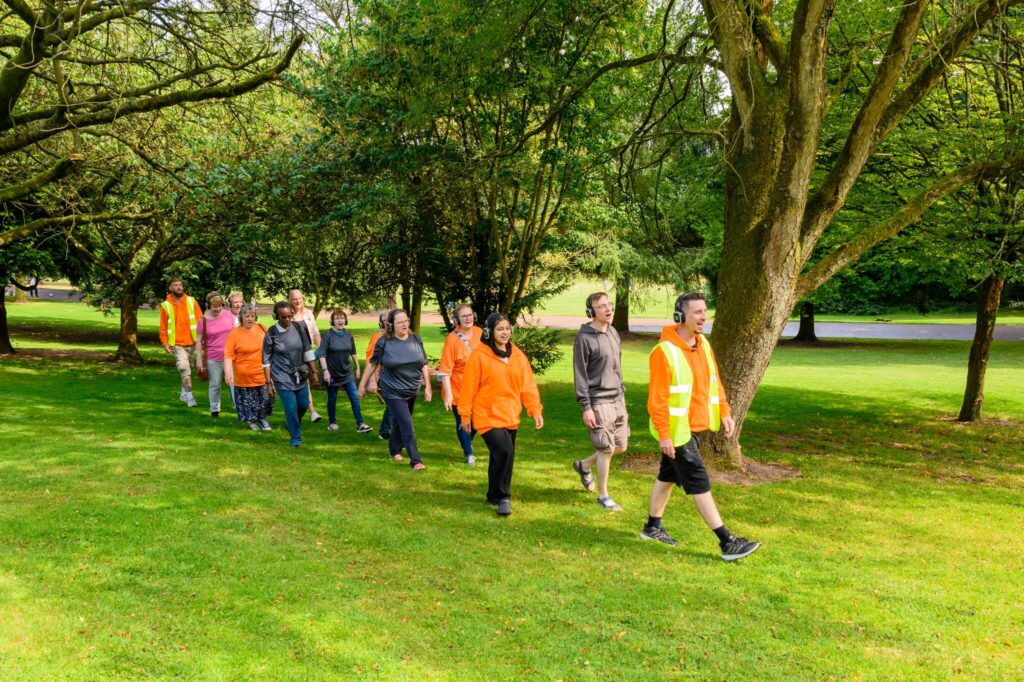
7:10 Matt: Excellent. Now, you’re here today to tell us about something totally different: the walking choirs – a completely free weekly session where singers can get their steps in and their songs out. So Chris, you founded the walking choirs. Let’s start with a big question: where did this innovative idea come from?
7:28 Chris: The initial idea actually goes back a few years, when my brother and I were in London. As we were walking through central London, we heard a group of people being led by a person with a megaphone, and they were doing army-style call-and-response things – a little bit like in the old movies. They were having an absolutely fantastic time, and it was out in public. It was brilliant, and it really made me start to think: how could we incorporate that into something a little bit more choral, a little bit more structured?
8:00 The reason that interested me was that I’ve always been an advocate of the health benefits of singing. The mental and physical benefits are really well known, and the health benefits of fitness, of course, are extremely well known. I’d love to be an advocate of the health benefits of fitness – I’m probably more of an advocate of the health benefits of singing! So I decided to put the idea to our CEO, and to look at how we could come up with a concept that could be more structured. We wanted to answer a fundamental question: if people are learning something new, and their brain is concentrating on that specific task of learning, will the brain even think that it’s doing exercise at the same time? That was the idea we wanted to have a go at. We ran some pilot tests with existing choir members, and it absolutely proved the concept. So we put an application in for funding, and we got funding from the SCVO, the Big Give and the National Lottery Community Fund. They funded us for all the equipment and all the staffing, so that people could have free access to take part in three walking choir sessions per weekend, completely free to them.
9:20 Matt: Brilliant. So what does a walking choir session look like, and what do people get out of it?
9:25 Chris: Each session is an hour long, and they’re specifically in really lovely parks, so there’s lots of really nice scenery – really fresh, outdoors. Everybody gets a pair of wireless headphones that’s connected to a transmitter from the choir leader at the front, which is connected to a music player, and the choir leader has a headset microphone and sings from the front. We start off with a five-minute physical warm-up, then we do about 50 minutes of walking around, and then another five-minute cool-down at the end. The music changes pace throughout. It’s a little bit like when you’re on a treadmill – to do a good workout, you do a few minutes of fast pace, then a few minutes of slow pace, and you keep changing it like that. Our music is designed to simulate that idea. And all the music is bespoke, so people won’t know the music beforehand, and that means they have to focus and concentrate on what they’re learning. So by the end of it, they have no idea that they’ve just walked two and a half miles! Everyone who takes part really, really enjoys it. They come out feeling really refreshed, feeling that they’ve genuinely got fitter in that period of time, and had a great time doing it.
10:40 Matt: Brilliant. And what’s the future for the project? It’s been running for a year now – where do you see it going?
10:45 Chris: What we’d really like to do is keep it accessible, for free, for as long as we possibly can, and we want to expand it. Currently we’ve got three sessions every weekend in two locations, and we’d like to expand that to six sessions over the weekend, in more locations. We’ve been in discussions with Sandwell Council and with Dudley Council about places where they would like us to take the walking choir, so we’re in the process of putting in an application for a large grant to allow us to do that – because we’d really love to be able to take the walking choir further out, and give even more people the opportunity to take part in something so brilliant.
11:35 Matt: Well, that’s absolutely wonderful. And if you fancy taking part in a walking choir event, you can find out where the next one’s happening at thepeoplesorchestra.com.
Mariann Harris on TPO's back-to-work support (11:44)
11:44 Matt: Next, we’re joined by someone whose work changes lives. Mariann Harris has been a key part of The People’s Orchestra for over a decade, supporting their back-to-work programme through her expertise in career coaching, CV writing and interview preparation. She’s helped over 1,500 people find their way back into paid employment, further training or higher education. Hello, Mariann!
12:05 Mariann Harris: Hello, Matt!
12:07 Matt: I know you’re very busy, so thanks for taking the time to talk to us.
12:10 Mariann: You’re welcome.
12:11 Matt: You’ve helped over 1,500 people move into employment, training or education. What first sparked your passion for helping people get back into work?
12:20 Mariann: My passion was first sparked a very, very long time ago, when I was doing a job that I disliked enough to leave and find my own way to the local Jobcentre, to look for something else. It was back in the days when Jobcentres had little cards with vacancies on display. So I found myself in there, talking to a member of staff, and they offered me a job – to work there. It was just a temporary cover over the summer period. But I simply never looked back. The sheer joy of being on the front line and meeting people day in, day out, sharing their job-search journey with them, and then seeing the end results, was just a marvellous thing to be part of. It sparked my passion enough not just to do it and stay in similar roles, but to expand it, and to thoroughly enjoy and breathe it, really. So yes – the passion was sparked by me being unhappy in a job I didn’t like, and just moving on.
13:45 Matt: I remember getting my first job, in a studio actually, from a card in a Jobcentre!
13:50 Mariann: Yes – those were the days! That was quite a nice thing. Things have changed a lot since then. The service is still there, to a large extent, but the cards as such, with the individual jobs on, have gone.
14:05 Matt: Can you share a success story that’s really resonated with you?
14:08 Mariann: There have been a lot of them, and I’ve been privileged to be part of a lot of them through the years. I suppose one that resonates with me is the support we were able to give to an older lady, in her 50s, who needed to change direction because of her health. She was advised to stop doing the physical work she was doing as a cleaner, and to look for something where she could sit down, and she was just completely cast adrift with that message. She found her way to us, and we were able to give some direction. She’d dedicated her life to bringing up a daughter, so lots of things resonated with me, and she just found herself in changing circumstances with her own health, needing that support to make a big change – a big transformation – in her life.
15:25 It was just a marvellous time to sit, listen and drink coffee with her, because we went right back to her school days. She’d done quite well, and the only subject she wanted to do better at, that she’d struggled with, was maths. And that was when I was able to say, “well, look, our local college does fabulous free maths courses, so let’s go and explore – let’s go and visit them and see what they’ve got on offer”. And she did. She not only came out of it with better maths qualifications than I’ve got, she was also able to move that into a full-time job with a central government department, with HMRC.
16:10 Matt: Wow.
16:12 Mariann: So she’d actually gone from being told “your health is struggling, you need to leave a cleaning job and do something sitting down”, to gaining very, very solid qualifications, and then the job of her dreams, in the tax office, with terms and conditions that are just fabulous.
16:35 Matt: Well, that’s amazing.
16:37 Mariann: And to this day we’re obviously still in touch. I think that is just the kind of thing that certainly makes my heart sing. There’s no better message to set you up to go on and on, with all the worries and concerns that people bring to our door. So yeah, it’s just lovely.
17:05 Matt: It’s very rewarding, isn’t it?
17:07 Mariann: Indeed it is. And she’s got such a lovely conversational manner that she’s the ideal person to have on a helpline like that – in a customer service role, where she can accurately and appropriately direct other people. It’s lovely.
17:30 Matt: Lovely. And do you think creative outlets like singing and performing can help with confidence and resilience in job seekers?
17:38 Mariann: Absolutely, I do – I certainly do. When it comes to something like singing and performing, it takes some guts, some confidence, and I think there’s no better way to build it than something like singing and performing. There’s very little in life… You can have a lot of ability, but there’s very little in life without some confidence to accompany it. So most definitely – they very much go hand in hand. And you do have to stand up and impress at a job interview. You can’t go in there without being able to display that confidence to get the job offer – otherwise you get a sad message that says “thank you, but not on this occasion”. So there’s a clear link there, most definitely.
18:40 Matt: Well, thank you, Mariann, for talking about absolutely vital work – I’m sure you’ll agree – and work that can’t be done without your valuable donations. So thank you if you have already made a donation through your subscription to the choir or the orchestra, and if you can afford to help more, please go to our website, thepeoplesorchestra.com, click on the Donate button and pledge whatever you can, so that we can continue our tireless charitable work. Thanks, Mariann.
Julie Lawrence on the Ringers Choir (19:04)
19:04 Matt: Our next guest is Julie Lawrence, a volunteer member of the Ringers Choir. The Ringers are a unique and passionate group of volunteer singers who travel to support other choirs. Not only do they gain fantastic opportunities to perform in different settings, they also play a vital role in strengthening smaller or new choirs, by boosting their numbers at performances. It’s a wonderful way to build connections, share the joy of singing, and ensure every choir gets the support it needs to create an amazing musical experience. Today we’re diving into what it means to be a Ringer, and why their work is so important. Hi, Julie!
19:40 Julie Lawrence: Hi!
19:42 Matt: So, Julie, what makes being a Ringer so special for you, and why do you do it?
19:46 Julie: I enjoy meeting people, and I love the community of the choir. And as a person who’s disabled, I can’t do a lot of things to help and support the community – but being a member of the Ringers Choir, I can help and support whoever we’re singing for, or the choirs that need a bit of support with their numbers.
20:10 Matt: So how does it feel, walking into a choir that you’ve never sung with before?
20:14 Julie: I feel that with The People’s Show Choirs, when you walk into any choir, you get a warm welcome from the choir members, because it’s like a big family. So even though you’re not part of their choir, they make you feel welcome.
20:30 Matt: And what’s been your most memorable moment as a Ringer so far?
20:34 Julie: A couple from this last year have been special. We sang for the Lord Mayor, which is something we don’t normally do, which was really nice. And we also sang at the QE Hospital at Christmas, for the staff and visitors and patients – giving them a bit of happiness around Christmas time, when it can be a bit depressing being in hospital, or being poorly.
20:58 Matt: Oh, that sounds wonderful. So you’re going to stick with the Ringers Choir for a while, are you?
21:02 Julie: Yeah – I’ve been in it from the beginning, and I go to most things, when I can, to help out.
21:08 Matt: It sounds like great fun. Thanks for speaking with us today, Julie. And if you’d like to get involved in the Ringers Choir, or anything else, get in touch at thepeoplesorchestra.com, or by sending us an email at hello@thepeoplesorchestra.com. Let us know what special skills you have too – we’d love to make the best use of your valuable time.
[Music]
What's coming up in March (21:26)
21:26 Matt: Coming up in March: on the 2nd, the spring interaction concert is at All Saints Church in Weston-super-Mare, where three of our choirs will be showcasing the fantastic repertoire they’ve been working on throughout the spring term. On March the 9th at 6:30pm, The People’s Big Band features as part of Birmingham Rocks at Snobs nightclub – admission is free, and it will last around two hours. And our choirs and orchestra are fine-tuning every note in preparation for our Mother’s Day concert, Back to the Movies, at Birmingham Symphony Hall on March the 30th. It’s shaping up to be an incredible event, and we can’t wait to bring it to the stage. Tickets are available through B:Music, so don’t miss out. We’re also looking ahead to the Scottish Highlands tour in May, which promises to be a breathtaking musical experience. If you’ve ever thought about joining us, now’s the perfect time – head to thepeoplesorchestra.com to sign up for two weeks free.
Outro: looking towards April (22:24)
22:24 Matt: Thank you for listening to this episode of The People’s Orchestra and Show Choir Podcast. Tune in next month, when I’ll talk with Julian Powell, one of the board of trustees, about what they do and what his role as a trustee involves. I’ll also be talking to Liz Read, who runs three of our show choirs, about how she finds the time for such a big commitment, and how each of her choirs has a completely different personality. Check out the website, thepeoplesorchestra.com, and follow The People’s Orchestra and The People’s Show Choir social media channels. And if you would like to find out about how I can help you with making a podcast for your organisation, take a look at my website, audioeditingsecrets.com, and follow my social media, which is @audioeditingsecrets, on Facebook, Instagram, YouTube and TikTok. I’ve been Matt Ward – thank you for listening.
[Music]
Previous episode · Season 1, Episode 2
February 2025: Poland, Shrewsbury and Cheltenham
Matt Ward talks to Nick Makwana about the 2024 choir tour to Poland, Lorna Parkhouse about the Shrewsbury choir's local performances, and Bonnie Toner about how the Cheltenham choir regrew from just four members.
Next episode · Season 1, Episode 4
April 2025: Inside The People's Orchestra
Matt Ward talks to first violinist and orchestra leader Mandy Toor, trustee and Rusty Players conductor Julian Powell, and Annie Routley, who has played viola with The People's Orchestra since its first rehearsal in 2012.