Just The Tonic with Katie Derham · Series 1, Episode 1
Just The Tonic, Series 1, Episode 1: The People's Orchestra
Released 29 September 2021 · 35 minutes · Presented by Katie Derham
Prefer to listen? Play the audio here, or listen on Acast.
🎵 Chapters
Jump straight to the part you want. Click any timestamp to play the video from that point.
🎧 About this episode
The first episode of Just The Tonic with Katie Derham introduces The People’s Orchestra: CEO Sarah Marshall on how it began, saxophonist Xhosa Cole, players Jacqueline Burke, Annie Routley and Nigel Tyson, orchestra manager Liz Read, and composer John Altman.
Episode details
- Released
- 29 September 2021
- Length
- 35 minutes
- Presenter
- Katie Derham
- Series
- Just The Tonic with Katie Derham
Questions answered in this episode
❤️ Get involved
Try The People's Show Choirs, The People's Orchestra or the Big Band – your first two sessions are free. Every membership funds our work supporting people into employment and through financial crisis.
Full transcript
This transcript was made from the episode’s captions and lightly edited for readability. Click any timestamp to play the video from that point.
Opening (0:00)
[Music]
0:10 Making new friends, de-stressing, learning to sing, boosting your confidence – just a few of the benefits of being involved in an orchestra, a band or a choir.
[Music]
0:24 “I’m by no means a good singer, so I’m never happier than when I’m just surrounded by good singers, thinking ‘is that me making that noise? Oh no, I don’t think it is’ – but never mind, that’s what you get with the community choir.”
[Music]
0:42 “I think it does amazing things for your headspace, emotionally and spiritually, to be in that environment, working together to produce something that is greater than the sum of its parts.”
0:50 “If you just give us a lovely, beautiful A, everyone’s just going to tune in together…”
0:58 “A community orchestra is more than sitting down behind a music stand and playing music. It’s about making friends, it’s about de-stressing, and it could sort out a lot of problems, through just playing music.”
1:08 “I used to be really shy and insecure, and learning an instrument has just brought me out of my shell.”
1:16 “Being an amateur musician brings great rewards. It’s just satisfaction – enjoyment is what I get from it.”
[Applause]
1:37 Katie: Music is pretty powerful stuff. You don’t need me to tell you how much it can help us escape or relax, comfort or energise. It’s been a complete lifeline for many of us over the past 18 months, that’s for sure. But music and all the arts do so much more than that, and in this new podcast series I want to shine a light on the extraordinary work that musicians do in all parts of our community to make people’s lives better. I’m Katie Derham, and I believe it’s just the tonic we need.
[Music]
2:13 We have truly appreciated films, books, streamed theatre, dance and music performances from our sofas during the pandemic, but there is nothing quite like the buzz of being in the room.
[Music]
2:30 In this series, with the help of The People’s Orchestra – a fantastic community orchestra in the West Midlands – I’m going to dig more deeply into the power of music and the arts: to help mental health and physical wellbeing, to get a job, to rehabilitate, to integrate, to educate.
2:51 I’ll be talking to people from organisations all around the UK who are making this good stuff happen. We’ll be hearing from Sir Mark Elder, music director of Manchester’s Hallé Orchestra…
2:58 Sir Mark Elder: Unless something happens, music will die totally in education. It needs leadership, it needs inspiration.
3:05 Katie: …from Chi-chi Nwanoku, who created the Chineke! Orchestra to give opportunities to Black and ethnically diverse classical musicians…
3:12 Chi-chi Nwanoku: I want to see Black people, Indian people – I want to see them at the back of the first violins, third trombone, second percussion. I want to see them there, not just the exceptional principal players. We need to be treated like everyone else.
3:30 Katie: …and from Charles Hazlewood, artistic director of Paraorchestra, which removes barriers for disabled musicians.
3:35 Charles Hazlewood: Let’s remember that actually 20% of the UK population identifies as disabled. I’ve been conducting orchestras around the world for about 30 years now, and I can count on the fingers of one hand the number of musicians who identify as disabled I’ve found in any of those groups over that long period of time.
3:55 Katie: We’ll be hearing from them and from other leading figures in the arts across the series. But in this episode, the focus is on The People’s Orchestra – a community orchestra and so much more, based in West Bromwich. You’ll be hearing from them as they showcase the fantastic work they do in the West Midlands, and every episode they’ll be picking up hints and tips from other like-minded organisations.
4:21 I first came across them when they took part in BBC Four’s All Together Now: The Great Orchestra Challenge back in 2016, our search to find the UK’s best amateur orchestra. Now, they didn’t win, but they impressed us all with their chutzpah and their joyful playing, and their heartfelt commitment to inclusivity in all its forms.
4:38 I’m not the only one they impressed. They’ll be picking up the prestigious Queen’s Award for Voluntary Service – which is kind of like the MBE for volunteer groups – at a ceremony in Birmingham in October 2021, for their work. They’ve taken part in flash mobs, they’ve played at a Comic-Con, they’ve helped kick-start the careers of young local musicians like saxophonist Xhosa Cole, who went on to become BBC Young Jazz Musician of the Year…
5:05 Xhosa Cole: For me, The People’s Orchestra felt like a space where I was with family, with friends, making good music, and felt supported.
5:13 Katie: …and they’ve worked with composer John Altman, who’s arranged the music for the most anticipated film of the year.
5:20 John Altman: I finished my work on Hans Zimmer’s score for No Time To Die…
5:26 Katie: No Time To Die is the latest James Bond film, just in case you didn’t know. We’ll hear from Xhosa and John later, but first, let’s head off to The People’s Orchestra HQ.
TPO Towers: Sarah Marshall (5:33)
5:33 Katie: So we’ve come into West Bromwich Town Hall, home to TPO Towers. Thanks for letting us come.
5:41 Sarah: It’s lovely to see you, Katie. Thank you for coming. Yes, we’re up here on the first floor of the town hall. Hi, I’m Sarah Marshall, and I’m the CEO of The People’s Orchestra.
5:52 Katie: So you are the power behind – you are the force of nature behind – The People’s Orchestra. Tell me how it started.
5:59 Sarah: Thank you. So we started about 10 years ago, originally as an Arts Council project, addressing the need for people coming out of schools who were educated really well in music but didn’t necessarily have anywhere to play.
6:18 Katie: And tell us a little bit about where we are now, because that’s a big part of why the TPO, The People’s Orchestra, is so important in this community, isn’t it?
6:28 Sarah: So The People’s Orchestra is based in the town hall in West Bromwich, in Sandwell. It’s quite a deprived area of the UK. It has quite a high unemployment rate compared to most areas, and when we set up here we found that a lot of the volunteers who were working with the orchestra at the time got into work quite easily. So from there we began to grow quite a large back-to-work project, and we now help about 80 people a year back into work – just by the fact that we’re here in Sandwell, running a fantastic creative arts project, and they’ve got lots of things to talk about when they go for an interview.
7:08 Katie: But tell us a little bit more, then, about what TPO actually is, because it’s more than just one orchestra. Well, for a start, tell us about the orchestra, because it’s quite special, isn’t it?
7:22 Sarah: The People’s Orchestra is a fantastically talented group of musicians. We don’t restrict numbers and we don’t restrict instruments, so we have a fantastic saxophone section, we can have up to 14 or 15 flutes at a time, and every time you come to a concert it sounds just a little bit different. They are a fantastic bunch of players.
7:41 We also have a Rusty Players Orchestra network, which is just starting up. They think they haven’t quite got the confidence to get into TPO – but they have, really; we’re just giving them a little bit of a boost. They’re doing a fantastic job. And we’ve also got a big network of choirs as well.
7:59 Katie: What you do here in West Brom, I think, sums up exactly what the joy of music is all about. Because yes, you do make a lovely sound – the TPO actually play really well – but it’s not just about that, is it? It’s about how you feel, and it’s the social side, and it’s keeping a skill going, and it’s being part of something bigger than yourself.
8:17 Sarah: What I do love about TPO and the way it’s set up now is that we’ve got such a big scope to help people. We’re now helping new arts leaders come in to music groups, and we can create more groups for them, to create new careers, which is great fun – we love that. We love supporting new music-making, so we can commission from new film composers who are composing at the moment for film, and it’s great to be able to highlight their music – and games music, we love playing those. So I really like the fact that we’ve got a big scope here. So it’s all brilliant.
9:00 Katie: And you help hundreds of people by providing these musical groups for them to play in. If you had to sum up why it’s so important that people can play in an orchestra or sing in a choir like the ones you organise, what would that be?
9:17 Sarah: I think it’s the health benefits of singing and playing music. That is the main difference that we see in people: the joy, the friendship, the confidence building. And that is even for people working with the orchestra as volunteers, but through the musicians and the singers, that’s the main thing we see. We would encourage anybody, anywhere, to get involved with making music.
Xhosa Cole (9:44)
9:44 Katie: One young local musician who played with the TPO early in his career has gone on to great things. In 2020 he received the Parliamentary Jazz Award for Best Newcomer and the Jazz FM Breakthrough Act. This year he released his debut album, K(no)w Them, K(no)w Us. I’ll let him introduce himself.
[Music]
10:13 Xhosa Cole: Hi, my name’s Xhosa Cole. I’m a saxophonist and composer, a former member of The People’s Orchestra and various other community outreach and integration arts programmes here in the home of more canals than Venice – Birmingham.
10:30 Katie: So listen, tell us a bit about the lovely People’s Orchestra. I’ve known them for a few years too – they do amazing work – but I’m really interested to hear how you first came across them.
10:40 Xhosa: So I came across The People’s Orchestra because I was fortunate enough to be in the music service in Birmingham at a time, as a young person, when there was lots of investment in the arts and arts programmes, and there were many different ensembles – some localised, some wider regional orchestras like the Birmingham Schools Symphony Orchestra, Junior Conservatoire wind orchestra, stuff like that. And I just fell in love with the feeling of being part of a much more macro sound, you know, contributing to an overall… I think it does amazing things for your headspace, emotionally and spiritually, to be in that environment, working together to produce something that is greater than the sum of its parts.
11:22 So I was kind of hooked on that kind of music, and then I was researching – I was thinking, right, I need to get involved in as many orchestras as I possibly can – and TPO was one of the first ones to pop up. Me and my brother both looked at it – he’s more of a commercial drummer, session musician, doing lots of work for dancers and stuff. TPO was a perfect environment for us to get our stuff together, basically, and to be able to share the space with some amazingly talented musicians that didn’t formerly have an outlet to express their musicality, necessarily.
12:03 Katie: And because you were such a good sax player, they’ve basically created a sax section – which is not a traditional section in an orchestra – and they’ve done it pretty much for you, as far as I can work out. So you have helped them create it.
12:18 Xhosa: Yeah – well, me and Janine (spelling unconfirmed), who’s another tenor player, who’s a really good friend of mine. I mean, from the get-go, I know that TPO had at the forefront of their values and objectives inclusivity of all kinds, you know what I mean? And that meant opening the doors to people who weren’t within the conventional, traditional format of classical musicianship. We all had the skills to be able to create great music, but the form and the means in which we did it varied more than you would find in a normal orchestra. So they were really accommodating, and yeah, it was unconventional, it’s always been a bit quirky – but those are my favourite kind of spaces, you know? So yeah, I felt right at home.
13:00 Katie: I’ll ask you a bit more about that – how you felt when you did become part of The People’s Orchestra, and being part of that kind of group, what it really meant for you.
13:10 Xhosa: Well, it’s one of those things. For me, The People’s Orchestra felt like a space where I was with family, with friends, making good music, and felt supported. There was a good balance of having a laugh but also taking the music seriously, which is really important for me. And I always loved the tea breaks – we had great craic. Me and Janine always had a great laugh, and the same with me and Mandy, the violinist, and Jacqueline, who’s top, top, top G on the flute and piccolo. I learned a lot from those players. Oftentimes, amateur musicians have a different emotional connection to music than a lot of professionals that I engage with, you know what I mean? There’s this real humility about it, and a real sincerity about it, and a real emotiveness to people’s playing.
Meet the players (13:56)
13:56 Katie: The People’s Orchestra, like many music groups, stayed connected over Zoom during lockdown, and they’d just started to get together again in the same space. Well, we went along to their rehearsal hall in Birmingham to meet them. Here’s Xhosa’s friend Jacqueline.
14:11 Jacqueline Burke: My name is Jacqueline Burke. I’m from Walsall in the West Midlands, and I play the flute and the piccolo in The People’s Orchestra. I chose TPO because I’ve always been in orchestras since I was little – school bands or whatever – and I hadn’t been in an orchestra or any kind of band for at least two years, and I really missed it, really craved it. And only by chance I saw an advert in the paper for TPO, so I emailed them and I got in.
14:43 The best thing for me about playing with the orchestra is it’s a great stress reliever. I struggle a lot with self-esteem and anxiety, and being able to chill out and calm down… The orchestra is a place where everybody gets on, and if you’ve got any problems with music, or with anything really, there’s always somebody there to help you. And when you’re sitting down in front of a music stand, you can’t think about anything else – and it’s deep breathing, and it’s concentration, and it’s physical. So what I get out of it is it just calms me down. It completely calms me down.
15:24 Karlina Walton (spelling unconfirmed): So my name is Karlina Walton, and I play piano, flute, and I sometimes help out on percussion as well. There’s a lot of fun. We’re standing right now in the interval, the sort of space we have for break time, and you can already hear some people are jamming – they’re breaking out into little groups, having a bit of a jam. There’s chatting in between. There’s a really good sense of community, which perhaps I haven’t necessarily come across in other orchestras I’ve played in in the past.
15:48 There’s no sense of “us and them”. You can sit across from brass, from strings and flute, and people will turn around and help you out if you need some help – struggling with a note, struggling with the time signature. Everyone’s there to pull together and help you get the best you can, rather than point fingers and say “oh, they’ve missed their entry again”. There’s none of that. You’re part of a big family, so that for me is probably the biggest draw.
16:08 But to play an instrument, having not touched it for 20 years – I have a full-time job, I’m a parent – to get my instrument out and play is such a release and such a great escape for me. So it’s the community feel as well as the opportunity to play my musical instruments again. It’s a really great lift to the week, really.
16:28 Katie: Here’s viola player Annie Routley on what she gets out of playing with The People’s Orchestra.
16:37 Annie Routley: The opportunity to play and improve my playing. Exciting concerts – just big, big highs. One of the outstanding things about the orchestra is our principal trumpet player, the pilot, Nigel Tyson. He’s just got a signature sound, and I’ve always loved the way he plays.
[Music]
17:10 The way I describe it is: he puts the thing on his face and the sun comes out. You only need one or two really key players for something to shine, and he’s that person for us.
17:27 Nigel Tyson: I started off playing in brass bands as a child, from nine. I lived in Queensbury – Queensbury’s famous for a world-class brass band, the Black Dyke Band. My first cornet was a Black Dyke cast-off that was in some attic or loft in the mill in Queensbury, and my mum worked there, so I got handed down that. It had bits of burnt newspaper and stuff in it, and it leaked – but anyway, it got me going.
[Music]
18:01 It’s a really great thing as a kid. You’ve got team building, you’ve got failure – which you get to understand, because not everyone succeeds at everything – but you get success as well, hopefully, along the way, and you do it as a team. So that was a wonderful education, although I didn’t realise it at the time. I learned how to play, basically. I never did any exams in music. I just learned by it soaking in as you’re playing through the different sections.
18:26 I like The People’s Orchestra. I’ve been in this for seven years. I’ve stayed in it and I don’t intend to leave, because we do vary what we play, and it remains highly satisfying. We do it as amateurs – we can choose whether we play or not – and I choose to play because I get so much out of it, so much fun out of it.
[Music]
Liz Read on what makes TPO different (18:55)
18:55 Katie: A rousing end there to Between the Skies, performed by The People’s Orchestra and composed especially for them by the film composer John Koutselinis. Inspiring stuff – lots of fun to be had at The People’s Orchestra, and crucially, for Jacqueline, health benefits too. I asked orchestra manager Liz Read what makes The People’s Orchestra stand out.
19:13 Liz Read: So The People’s Orchestra is a true community orchestra. There’s no limit on the number of people that we have in sections. For example, in a standard classical orchestra, especially in woodwind and brass, there are limits as to how many flautists you could have. We don’t limit in that way, which means we do need to listen and balance a lot more, because we sometimes have a very large section of one instrument and not many of others. So it means we do have challenges in different places, but that means anyone can come and play. The whole goal is to get as many people playing music as possible with The People’s Orchestra.
19:59 Katie: And it’s not formal, is it?
20:01 Liz: No, no, it’s very relaxed. We sort of refer to ourselves as the TPO family.
20:05 Katie: When I first met TPO, I couldn’t get over how literally colourful you are. Tell us a bit about that.
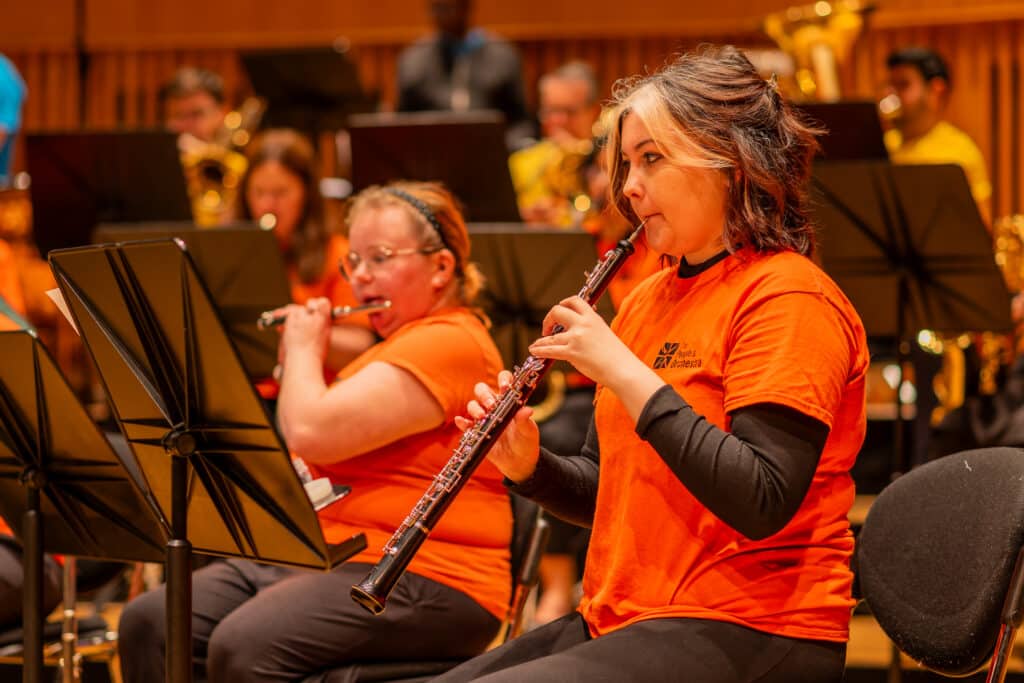
20:12 Liz: Yes, we have very bright T-shirts. Each section of the orchestra has a different colour: the string section is green, the woodwind section is orange, the brass section is yellow and percussion is blue. And we have that colour on our T-shirts for concert days, so when you see The People’s Orchestra on stage you see these blocks of four really bright colours, and it looks really quite eye-catching. Some players grumble at times – I do remember when I first got handed a bright orange T-shirt as a flautist, thinking, “this is an interesting concert dress” – but when you see pictures and footage, it does look really striking. If the woodwind and the strings sit next to each other, they look like Tic Tacs, because one’s wearing green and one’s wearing orange.
21:03 And also, on every T-shirt your instrument is on that T-shirt in black, and it’s got The People’s Orchestra and it’s got your instrument on it. That’s how people think, “oh, that’s what an oboe looks like”, or “that’s what a trombone looks like”. Now, that sounds ridiculous, but not everybody knows what a French horn is, nobody knows what an alto sax is. So we tape you out, and they go, “oh, why is that section different?” It makes people ask questions, and that’s how you learn. And when you learn, you break down barriers – and that’s what TPO is: breaking down barriers. There shouldn’t be any barriers to learning music, or joining in music, or creating music.
[Music]
21:52 The orchestras I’ve been in before, they think it’s Mozart, Mahler or nothing, and anything else is rubbish. And TPO is so refreshingly not like that. We play film music, we play TV music. It’s making people think – you know what, I’ve always thought orchestras were a black-tie thing, and it was for elitist rich people – and we’re going, actually, now you can bring your nan to our concerts. You know that advert that you like, that sells aftershave? We know that music, we’ve been playing that. Or you know that film you like, like Frozen or How to Train Your Dragon? We’re playing that music. It’s for everybody.
[Music]
John Altman (22:37)
22:37 Katie: So we’ve been listening to The People’s Orchestra performing specially commissioned work by the award-winning film composer John Koutselinis, who’s worked with them for a number of years now. Never shying away from a challenge, that piece, War of the Titans, was their first virtual performance. It was recorded during lockdown with their friends from Canada’s Orchestra Philharmonia Mundi of Montreal and Orchestras Central in New Zealand (spelling unconfirmed).
23:00 They’ve also worked with another award-winning film composer and arranger, who’s been working on the music for the latest James Bond film, No Time To Die. John Altman composed music for Titanic. He’s arranged music for Monty Python, including Always Look on the Bright Side of Life. He’s arranged and composed music for TV and for commercials. He’s an accomplished saxophonist – he’s played with Jimi Hendrix, Bob Marley and Little Richard – and he has his own big band. He’s conducted the Royal Philharmonic Orchestra, and crucially for this podcast, he introduced his friend Karlina, who we heard from earlier, to The People’s Orchestra. And she caught up with John over Zoom to have a chat.
23:37 Karlina: How did you come across The People’s Orchestra? Can you remember that day?
23:40 John Altman: Yes – they wrote to me. It was either an email or on Facebook, I can’t quite remember which, and asked if I’d be interested in writing something on commission for the orchestra. And I went up to hear the orchestra in rehearsal, and I was very taken by a young lad called Xhosa Cole, who then was a teenager. Subsequently he’s become the BBC Young Jazz Musician of the Year and got his first album out, and all kinds of wonderful things have happened. But I thought it’d be fun to write a piece featuring the whole orchestra, and particularly him as a soloist. It was great fun to do.
24:27 Karlina: So how did you go about writing for an orchestra like The People’s Orchestra? We’re not a traditional 50-piece orchestra – we have certain music desks which have perhaps more members than other orchestras might have.
24:37 John: Interestingly, I began my arranging career working on behalf of the BBC for record companies. My remit was to listen to cassette recordings of records by artists from either the States or France, occasionally even the UK, who didn’t have access to their music. In those days they would just fly over and appear, and expect to go on television. And what my job really was, was to transcribe from the cassette the backing that was on the record, and then adapt it for the peculiar line-up of either the Parkinson show, The Two Ronnies, Top of the Pops – any of the variety shows that existed in those days.
25:41 So very early on I learned to write for an orchestra that was not necessarily what you actually heard on the recording. For example, you might hear a string section on the record, but the band of the particular event just had woodwind, so you would then rewrite the string parts to be playable by the woodwind section without sounding completely out of place or out of character. So when I saw The People’s Orchestra rehearse and I worked out what the line-up was – although it wasn’t a conventional orchestral line-up, it didn’t faze me at all. The great thing about it, of course, is everybody is there because they want to be there. So there was no idea that you were going to write for a team of jaded professionals.
26:34 Karlina: I know certainly that, as an orchestra, we want to do that experience again, and it’ll be amazing. Going forward, what projects have you got on the horizon? What are your next steps? What are you doing now?
26:45 John: Well, my main focus at the moment is my autobiography, which I’m just in the process of completing. The book is called Hidden Man, which is a title bestowed on me by Terry Gilliam of Monty Python, because he said, “you’re the hidden man – you’re behind everything that we know, but nobody knows who you are”. I’ve had a wonderful career that stretches from the days of Muddy Waters and Peter Green and Jimi Hendrix all the way through to John Legend and Pharrell and Mark Ronson.
27:21 And my mother’s brothers – two of them were very famous musicians. One led England’s top Dixieland band and was Britain’s top arranger before the war, and was a friend of Puccini, and played in Louis Armstrong’s band…
27:43 Karlina: Serious pedigree!
27:44 John: Yes. And then my youngest uncle was conductor for Frank Sinatra and Judy Garland and Nat King Cole and Dean Martin. And these are all the people I grew up with when I was a kid, so I couldn’t really avoid being immersed in the whole of 20th-century show business.
28:03 Karlina: I wanted to ask about your experiences in the last 18 months, as the world got shut down due to the pandemic. As a musician, how have you found a way to get through these difficult times?
28:18 John: Well, it’s been unusual, of course, as we all know. I finished my work on Hans Zimmer’s score for No Time To Die just weeks before the first lockdown – it was virtually two weeks later and it wouldn’t have happened. Writing and playing music is a different animal. I galvanised myself into writing by deciding that I should start celebrating some of the things I’ve done in terms of my big band, which I’ve always kept separate. My big band was used in quite a few films, like Shall We Dance, Little Voice, Funny Bones and various others, and also on record with Björk (“It’s Oh So Quiet”), George Michael (“Kissing a Fool”) and Alison Moyet (“That Ole Devil Called Love”). And I thought, you know, I should be celebrating that side of my life, not compartmentalising it away. So I started writing big band arrangements of “Bright Side of Life”, “Kissing a Fool”… I spent time doing that, basically. And I try and play a little bit every day, just to keep my hand in, hoping that one day I’ll be playing again in public – which is what we all love to do.
Back at TPO Towers (29:49)
29:49 Katie: Absolutely. I am so impressed that The People’s Orchestra can commission composers like John Altman to work with them. I look forward to reading that book too. And I should say my thanks to Karlina for doing that interview with John. Members of The People’s Orchestra – both players and behind the scenes – are going to be getting their hands dirty and helping with all elements of production. It’s all part of their ethos of helping members of the community learn new skills.
30:13 Meanwhile, back at TPO Towers: one of the reasons that we’re making this podcast is because of the outreach work you do, and the benefits that I think you embody – how music and the arts can transform people’s lives in different ways. What are your ambitions? What are you hoping to get out of and learn from doing this podcast? Because we’re going to be talking to all sorts of organisations, aren’t we?
30:36 Sarah: I would really like to know what good things are happening out there. What other things can we do to help here – but also, how can we help in other communities similar to ours? I think that’s really important.
30:50 Katie: What would be the dream for you, then, with TPO at the moment? Maybe you will be inspired in all sorts of as-yet-unknown ways as we go around and meet lots of people, but right now, what’s the dream for The People’s Orchestra itself?
31:02 Sarah: I want them to be able to play some of the best music from some of the best film composers, and actually be able to go and play those live to film. We’ve done it a bit; we could do that much more. I’d love to have a network of Rusty Players Orchestras, because they are great fun, and be able to bring them together in big mass events that ordinarily an orchestra might not be able to do on its own – and to back that up with fantastic singers who maybe haven’t had a chance to play an instrument, or would love to perform, would love to be on a stage with a full live orchestra. Because by having everything, we can put on some fantastic events.
31:51 Katie: What are the biggest challenges to doing that for you?
31:55 Sarah: Our biggest challenges, especially here, are a lack of venues – a lack of venues that are the right size to be able to do what we want to do, available at a cost for a charity orchestra. There are some brilliant venues in the centre of Birmingham, but they are really outside the scope that we can manage. So really, venues are a big issue.
Close (32:23)
32:23 Katie: So if anyone listening has advice for Sarah, or is interested in finding out more about The People’s Orchestra, head to their website: thepeoplesorchestra.com. But for now, thanks to The People’s Orchestra, and to Xhosa Cole, John Altman and John Koutselinis. I do hope their stories have inspired you to brush up an old instrument and get involved. It really could be just the tonic you need.
32:50 In the next episode we’ll be meeting members of The People’s Show Choir, and we’ll be at the beautiful Hallé St Peter’s in Manchester, home of the Hallé Orchestra’s rehearsals and recordings. We’ll be speaking to the singers of the Hallé Ancoats Community Choir, and asking Sir Mark Elder, the Hallé’s legendary music director, about the work they do in their local community.
33:13 If you’re thinking about maybe joining a choir or a community orchestra, or looking for musicians to get together and start a band, search online for community arts organisations in your area, or you can get in touch with Arts Council England, Arts Council of Wales, the Arts Council of Northern Ireland or Creative Scotland. But I’ll leave you with some words of encouragement from The People’s Orchestra’s Jacqueline Burke.
33:36 Jacqueline Burke: If there is any community orchestra near you, or a community choir near you, I cannot recommend it enough. A community orchestra is more than sitting down behind a music stand and playing music. It’s about making friends, it’s about de-stressing. So I would strongly advise you do it. Don’t think twice, just do it.
33:55 Katie: Just The Tonic with Katie Derham was produced by Jill Davis and is a Peanut and Crumb production, supported by The People’s Orchestra and Arts Council England.
[Music]
Next episode · Series 1, Episode 2
The Power of Song
Katie Derham explores the benefits of singing in a choir with TPO's Halesowen Show Choir and choir leader Ula Weber, the Hallé Ancoats Community Choir, Baz Chapman on social prescribing, and Sir Mark Elder.