Just The Tonic with Katie Derham · Special
Just The Tonic Special: Celebrating World Singing Day
Released 14 October 2022 · 16 minutes · Presented by Katie Derham
Prefer to listen? Play the audio here, or listen on Acast.
🎵 Chapters
Jump straight to the part you want. Click any timestamp to play the video from that point.
🎧 About this episode
A World Singing Day special with Nicky Spence, TPO choral director Ula Weber, the Hallé Ancoats Community Choir, Sir Mark Elder and Lesley Garrett.
Episode details
- Released
- 14 October 2022
- Length
- 16 minutes
- Presenter
- Katie Derham
- Series
- Just The Tonic with Katie Derham
Questions answered in this episode
❤️ Get involved
Try The People's Show Choirs, The People's Orchestra or the Big Band – your first two sessions are free. Every membership funds our work supporting people into employment and through financial crisis.
Full transcript
This transcript was made from the episode’s captions and lightly edited for readability. Click any timestamp to play the video from that point.
Introduction (0:00)
[Music]
0:05 “There is something about singing as a group that just gives you such a great positive feeling.” “Well, if you want to be happier, if you want to have a lot of fun, and you want to be able to express yourself, there’s nothing better than a choir.” “I just love being part of a choir, that’s the main thing. And it’s amazing when you live in a big city to find a big group of people that you can call your friends.” “It’s a cliché again, isn’t it – keeps you young. I think it does.” “Yeah, it’s great exercise.”
0:40 Katie: Making new friends, reducing your stress levels, beating the blues, even keeping you young – just a few of the benefits you get from singing together in a choir.
[Music]
0:50 Welcome to Just The Tonic with me, Katie Derham, the podcast that explores how getting involved in the arts does so much to make our lives better. In this special edition for World Singing Day, on October the 15th, we are celebrating the power of song.
[Music]
1:10 So what is World Singing Day, I hear you ask? Well, it’s a global sing-along held every year, with the aim of bringing people together in communities all around the world through the simple act of singing together.
[Music]
1:35 Now, if your singing experience amounts to basically singing in the shower, that’s OK – it’s not a competition. You can sing at home with your family and friends, or you can join in a World Singing Day event in your area. If you would like to get involved, you’ll find all the information on the World Singing Day website, at worldsingingday.org.
Nicky Spence: singing as a superpower (1:54)
1:54 Katie: There are countless studies that tell us singing helps you feel better. Learning lyrics can help improve your memory and boost your confidence. And as opera singer extraordinaire Nicky Spence told me, it made him feel special when he was having a hard time at school.
2:08 Nicky Spence: Singing was a bit of a superpower for me when I was a ginger, fat, possibly homosexual eight-year-old, thinking, “how am I going to make this work? How can I keep the bullies away?” So I saw that I could sing, and that was like a superhero cape for me, in a way, and kept people away. So I thought at that point that was my USP, because it got people off my back – I could just sing at them!
2:35 Katie: So did it actually successfully become your superpower?
2:38 Nicky: It did, absolutely – with the bullies it was that, and a kind of propelling cagoule in the school ground, with the toggles, which can be quite violent! So that was my saving grace.
2:50 Katie: So singing for you was a joy, but also an escape, and a weapon in a way – I don’t wish to use military language with a glorious art form, but it was something you used to protect yourself. Let’s talk about Anyone Can Sing – the Sky Arts programme in which you took some great characters who thought they couldn’t sing, and you magically transformed them. Is that something you’ve now been sharing with these lovely amateur singers – that access to the superpower, if you like?
3:20 Nicky: Absolutely. They were all such glorious, charismatic creatures in their everyday lives – even if they were plumbers, and we had the Dean of King’s College – but they all had some kind of trauma, something that they had to try and unpack, with this feeling that when they sang, actually, it was something very, very deep-seated. And often their aural perception of their own voices switched off – they went into this trauma. So, as always – I do lots of mentoring and teaching of young folk – it’s generally trying to peel back these layers of “why are you not releasing?” Because singing opera is basically about release; that’s how you make a big sound. But it’s difficult to know your body, and to know yourself mentally well enough, to be able to deliver that and be vulnerable enough – because it’s so vulnerable, as you know. It’s your soul on a dinner plate.
4:15 Katie: So how did you help them work through that, through the power of song?
4:23 Nicky: Well, it’s looking first of all at why they want to sing – what it is they want to achieve. With our lovely Dean of King’s College, she felt as if her clergy box was missing a tool, because she always wanted to encourage people to sing to be closer to God, and she felt she’d be praying threefold if she could sing as well. But she couldn’t do that. She thought she was absolutely marooned from the island of melody – she thought she was tone deaf. And actually, I had to try and distract her while she was singing – I used to throw household objects at her, as you probably saw in the series – just to try and distract her so she could sing in tune, because she was switching off as soon as she made a sound. Because she was told she was a crow when she was at primary school, which is just horrendous.
5:10 Katie: This is vaguely reminiscent of The King’s Speech, isn’t it – the Colin Firth film where his voice coach would be saying, “just think about music, think about anything”, in order to distract him from his stammer. It is a fascinating thing, isn’t it, that we all have this ability, and yet something can block it in that way.
5:30 Nicky: Well, I think we block ourselves all the time with all kinds of things. I’ve worked with professional singers and had them whirl things around their heads just to try and distract them. And I myself have got myself in a right pickle with difficult opera roles, just thinking, “well, there’s absolutely no chance I’m going to be able to do this”. And most of it is psychological planning – like an athlete, dare I say it, with my physique! But it’s true: it’s all about planning, and about psychology in the end. That’s what makes it a hard business.
6:00 Katie: How do you do it, then? What’s the trick? Because if any of us listening could access even a fraction of your voice for ourselves, it would be truly amazing. How do you get yourself into the headspace where you think, “no, I’m not going to be beaten by that role, or that note”?
6:20 Nicky: Well, for me, I never really think of my voice as being particularly good, but I think I’m a good storyteller, and I have got some pipes in there, which are like the supporting actor to my need to communicate, if you will. But if it comes to, say, nerves – I’ve spoken to lots of therapists about this – often it’s about nerves and about your perception of what other people might think, and I’m sure we all go through life dealing with that concept. I had a breakthrough as soon as I started to look at where these nerves were coming from. Actually, often they’re from a really good place, because we want to do our best, and we want people to think good things about us and feel genuinely joyful. And as soon as you reframe it through that prism, and think, “actually, they’re there for a good reason” – they’re almost like bodyguards in the room, winking at you, just to say everything’s all right. As soon as you have that relationship with nerves, or with this feeling of judgement, you can actually tip your cap to them and say, “please leave now – I know you’re here for a good reason, but I don’t need you just now”.
Ula Weber: anyone can sing (7:28)
7:28 Katie: I love that idea of your nerves being a bodyguard instead of a threat. So if you feel nervous at the thought of singing in front of other people, just remember Nicky’s wise words. And if you have ever been told you can’t sing, here’s The People’s Orchestra’s choral programme director, Ula Weber, to reassure you.
7:45 Ula Weber: You know, I come across this time and time again when I’m working with teachers who were tapped on the shoulder when they were at school and told “you just mime”, and it stays with them for the rest of their lives. It’s such a negative experience. So I would say to those people: it is absolutely not true. A lot of children and young people don’t develop their singing voices until they’re quite a bit older, so we should be encouraging people of all ages to sing and enjoy singing. So I would say come along to a choir. A choir is the best way for you to improve your singing, improve that inner ear, work on pitch, and work on all those things that a choir can do – and it will ultimately develop confidence.
8:30 Katie: So there you have it – Ula believes that anyone can sing. So if you’ve been told in the past that singing is not for you, perhaps it is time you gave it a go.
The Hallé Ancoats Community Choir (8:40)
8:40 Katie: We’re heading north to Manchester now, to hear from the fantastic Hallé Ancoats Community Choir.
8:50 Jim Battle: One of the risks of being a man in a choir is that there’s probably fewer men than there are women in the choir, and therefore basses and tenors – sometimes you might feel you’re doing a solo part. But I think it’s important that we try and build that up, and that you can break some of the myths down. You know, what are the barriers for men coming to sing? I must admit I was nervous. I didn’t want to show myself up. I was afraid it might have been too technical. I’m not a musician. I didn’t think I had a very good singing voice – I probably haven’t got a very good singing voice – but enjoying singing, and enjoying singing with others, I think is something we could actually promote. I think we’ve got a barrier to overcome, persuading men. I think they’ve managed to do it in Wales with the male voice choirs, so I’m pretty sure we could try and do that in Manchester.
[Music]
9:46 Katie: The men of the Hallé Ancoats Community Choir in great voice there – and it would be fantastic to hear more basses and tenors in community choirs all over the country, because, as we’ve heard, it’s not only great fun, but there are such great health benefits too.
[Music]
10:05 Hannah Messer: Absolutely, the choir makes a huge impact on your mental health. I think that is one of the main things that people gain from it. There is something – I’m sure it releases endorphins or something – singing in a group. But it does just help you relax, focus on something else. And even just the act of focusing on your breathing, and just standing still and thinking about something else for a short period of time, makes such a huge difference. I always feel like I come out of it in a much better mood, and just feeling a lot more resilient afterwards. It really does make a big impact on your mental health.
10:35 To be part of something bigger than yourself, to be a small cog in a very big wheel, can be life-changing.
10:42 It’s good for things like your memory – having to memorise all these songs just kind of keeps you… I suppose it’s a cliché again, isn’t it – keeps you young. But I think it does.
10:55 Sir Mark Elder: It’s a lovely fact that when people sing together, little by little their heartbeats become the same. And the idea of a shared heartbeat is a wonderful image, isn’t it? That you can get not only your sense of rhythm and your sense of pitch coordinated, but the pulse of your body as well. And people can lose themselves in this, and they can find excitement in it in a way that they’ve experienced in no other part of their life.
11:22 Katie: Big thanks to Mark Elder, the Hallé Orchestra’s music director – I love that idea of a shared heartbeat – and to the members of the Hallé Ancoats Community Choir.
Lesley Garrett (11:30)
11:30 Katie: And now from one group of fabulous singers to another: the national treasure that is soprano Lesley Garrett. What a woman! Here she is talking about how singing can have a positive effect on people with Alzheimer’s.
11:42 Lesley Garrett: I heard about a wonderful project they were doing at Plymouth University – I think it was a PhD student, a few years ago now. He was working with early-onset Alzheimer’s sufferers, and he set a list of tasks to music – to some music that the Alzheimer’s patient would know – just things like “I get up and brush my teeth, and then I walk the dog”, something like that. And when he set these tasks to music, they didn’t forget one. They got up and did all of those tasks.
12:20 Katie: That is an excellent tip.
12:22 Lesley: Absolutely. So you don’t need to convince me of the power of music to improve society, to heal at its most basic – but also to hold us together, mentally and physically. When you take in a breath to sing – not for nothing is it called inspiration. That’s always struck me: you inspire a breath, and then what you can make with that breath is also inspirational. A breath to sing is not like a breath to do anything else. It’s not like a breath to talk, or to whistle, or to shout. It’s a breath that’s going to turn into sound, and that sound has the power to heal. Now, that is the most profound thing any of us can do – and we can all do it.
13:20 I’m going to have to do it while I’m talking to you, because I just have to! You can start to sing properly – and this has nothing to do with doing it professionally. You have to stand tall, you have to stand square, you have to find the strength in your body. You have to allow your body to take in – to inspire – this magical air that’s going to create sound, that’s going to liberate you as a human being. You’re going to fill a room with sound – even if it’s your bathroom. You’re going to make the air move in that room. It’s going to connect you with your inner authority. It’s going to make you strong. It’s going to do you good. Anybody can do it – that’s what makes me excited. Even if the sound you make is horrendous, it’s yours. It’s your sound; you can do what you like with it. I just think the power of that is… Maybe this is what I should do in my retirement!
14:35 Katie: This is your mission, Lesley, now that you are officially, as you say, a national treasure, and you’ve been on a bus with Cliff Richard. Everybody’s got to listen to you, and everybody’s now got to sing!
14:45 Lesley: It’s so powerful, Katie. You sing, and it just makes you feel so good. For me, it’s like brushing my teeth – I just have to have a belt, and it connects me up. The whole of me is connected then – mind, body, soul, spirit – and then I’m able to be outward, to see outwards, because I’ve sent something out into the stratosphere. I’ve sent a sound out that I care about.
Close (15:25)
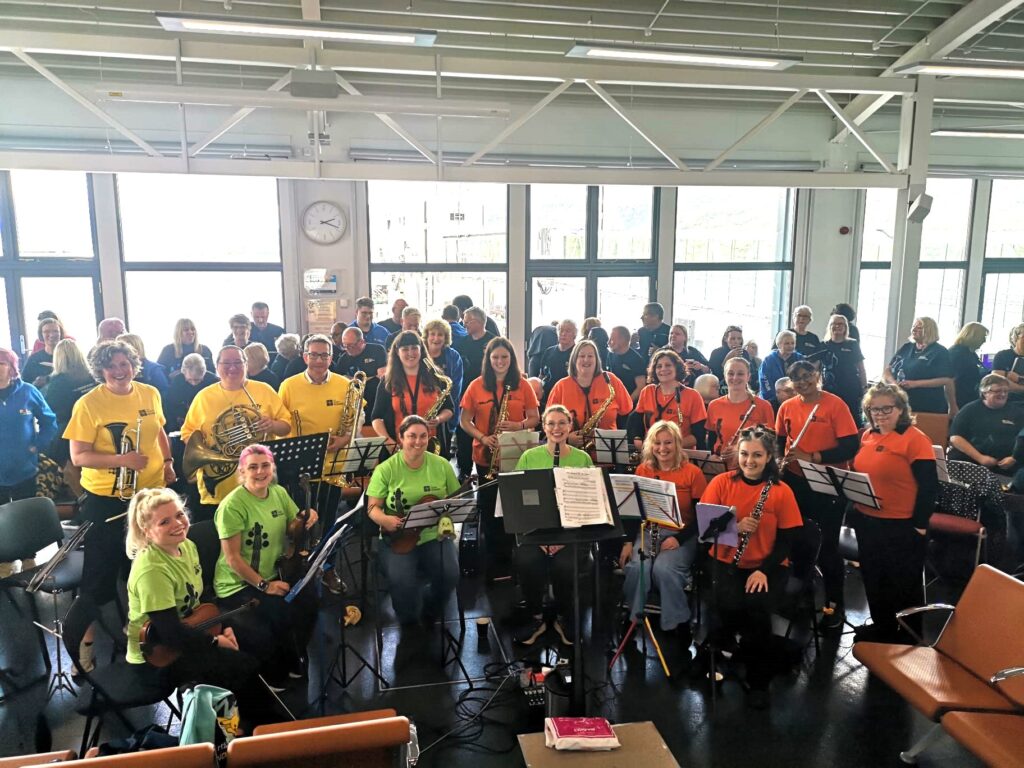
15:25 Katie: Thank you to Lesley Garrett, to Nicky Spence, Mark Elder and the Hallé Ancoats Community Choir, and of course to Ula Weber and The People’s Orchestra’s Halesowen community choir as well. Well, I hope we’ve inspired you to take part in World Singing Day. For more information on how to join in, head to worldsingingday.org – or join a choir. And if you really don’t fancy singing, why not support your local choir next time they perform? For information on choirs and singing groups in your area, do get in touch with Arts Council England, the Arts Council of Wales, the Arts Council of Northern Ireland or Creative Scotland.
16:00 Just The Tonic with Katie Derham was produced by Jill Davis. It’s a Peanut and Crumb production, supported by The People’s Orchestra and by Arts Council England.
[Music] [Applause]
Previous episode · Series 2, Episode 6
Music is for Celebrations, with Kit de Waal
The Series Two finale: new members of The People's Show Choirs at Birmingham 2022, Laurie Stanton of the Morriston Orpheus Choir, and author Kit de Waal on her memoir Without Warning and Only Sometimes.