Just The Tonic with Katie Derham · Series 2, Episode 5
Just The Tonic, Series 2, Episode 5: The Taste of the Opera, with Nicky Spence
Released 11 August 2022 · 35 minutes · Presented by Katie Derham
Prefer to listen? Play the audio here, or listen on Acast.
🎵 Chapters
Jump straight to the part you want. Click any timestamp to play the video from that point.
🎧 About this episode
Tenor Nicky Spence on singing as a superpower, English National Opera‘s AbracadOpera! with pupils in Croydon, and members of TPO’s Rusty Players Orchestra with conductor Bradley Wilson.
Episode details
- Released
- 11 August 2022
- Length
- 35 minutes
- Presenter
- Katie Derham
- Series
- Just The Tonic with Katie Derham
Questions answered in this episode
❤️ Get involved
Try The People's Show Choirs, The People's Orchestra or the Big Band – your first two sessions are free. Every membership funds our work supporting people into employment and through financial crisis.
Full transcript
This transcript was made from the episode’s captions and lightly edited for readability. Click any timestamp to play the video from that point.
Introduction (0:00)
[Music] [Applause]
0:05 Katie: Hello, and welcome to Just The Tonic, the podcast that shines a light on the power of the arts to make our lives just so much better. I’m Katie Derham, and this is the fifth episode of series two. If you’d like to catch up on episodes you’ve missed, or maybe have a listen again, you will find us wherever you get your podcasts – we are in all the usual places.
[Music]
0:32 Now, you may well be aware that the Proms are in full swing at the moment, featuring musicians from all over the world at the top of their game, like violinists Alina Ibragimova and Pekka Kuusisto, pianists Leif Ove Andsnes and Yuja Wang. But let’s face it, not many of us will ever reach anywhere near the skill level of those fantastic musicians. Of course, that shouldn’t stop us from having a go – and in this episode we’re going to be hearing from The People’s Orchestra’s Rusty Players.
1:00 Mike: Many orchestras have a minimum standard that I’d probably fail, most of them – but Rusty’s was ideal for me.
1:05 Katie: We’ve been speaking to some young people in Croydon to find out what they think about opera…
1:10 “I only thought that it was only singing very loud, and it would be a bit boring. But when I got there, I got very, very surprised, because they were singing and acting at the same time.”
1:22 Katie: …and I’m going to be having a chat with one of the finest opera singers in the land – the one, the only, the force of nature that is Mr Nicky Spence.
1:32 Nicky Spence: Singing was a bit of a superpower for me when I was at the age of eight, thinking, “how am I going to make this work? How can I keep the bullies away?”
1:42 Katie: Now, in the last series, singers in the Hallé community choir and The People’s Orchestra Halesowen Show Choir told us how much they benefit from singing together. And maybe you think, “well, I can’t sing”. Well, don’t worry – Nicky’s got some great tips for you, and I look forward to hearing more from him later.
[Music]
The Rusty Players Orchestra (2:05)
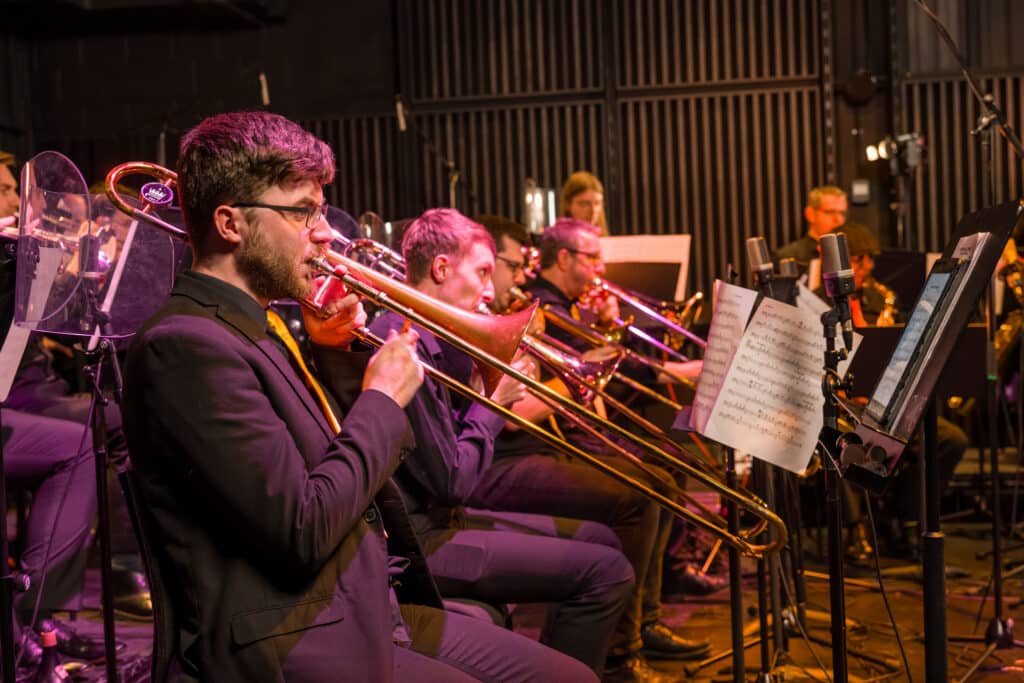
2:05 Katie: But first, we’re going over to musicians from The People’s Orchestra who are what it says on the tin: they are rusty players. Perhaps they’ve not quite got the confidence to play with the main orchestra; perhaps they’ve never even played with an orchestra at all. But the Rusty Players Orchestra gives them the opportunity to make music regardless of ability. They recently performed with the main orchestra and the show choirs at the Birmingham 2022 Festival, All Around the Commonwealth, and we caught up with them at rehearsals. Here’s French horn player Mike.
2:37 Mike: Before I moved to Birmingham, I hadn’t played my horn in an orchestra for a couple of years, so I was rusty, and I was looking for something I could just go along to that would accept me for the standard that I was. Many orchestras have a minimum standard that I’d probably fail, most of them – but Rusty’s was ideal for me.
2:58 Amy Marshall: Hi, I’m Amy Marshall, and I play the French horn. I joined the Rusty Players Orchestra because I needed to get back into playing. I hadn’t played my French horn for such a long time, and I had some really big, important concerts coming up that I wanted to get back into practice for. It’s so important to keep live music going, and it’s really nice to have this musical skill that I’m getting back into, for the first time in a very long time. I’m really enjoying playing again, and it’s with such a lovely group of people. It’s a lovely conductor – really welcoming.
3:30 Bradley Wilson: Hi, I’m Bradley. I am the conductor of the Rusty Players Orchestra, so it’s my job to lead rehearsals, choose the music we’re going to play for concerts, and just make sure that everything’s sounding good and everyone’s feeling happy with what they’re doing. Unlike other orchestras, where you have a very intense concert programme and very intense rehearsals, we rehearse in a very laid-back way. It’s actually near a bowling alley and a pub, which is great for socials after the rehearsal!
[Music]
4:15 “It’s always fun, and we have a good time. People support you. I’m very, very rusty, but others who are much better than me support me, so that helps.”
4:25 Laura: My name’s Laura, and I play tenor horn. I think my favourite moment was when I was able to play the pieces that they were playing – I felt like I was joining in with everybody.
4:40 Ian: My name is Ian. I play the trumpet. I am rusty – I’m starting back playing, and it’s a good place to begin. It’s very friendly, and it’s gone really well.
4:50 Kerry: My name’s Kerry, and I play the bassoon in the Rusty Players Orchestra. It’s a really safe space to try out, to see if you can still play – and then you’ll surprise yourself.
5:05 Kevin: It was a challenge – more of a challenge, really, to be honest with you. I just wanted a new challenge. I’m Kevin, I’m a bassist. I played in covers bands, and in a couple of unsigned bands prior to this, and I just wanted to do something different.
5:19 Bradley: We can accept almost any instrument – even one which wouldn’t fit in a traditional symphony orchestra.
5:25 Sang: Hi, I’m Sang, and I play the alto saxophone.
[Music]
5:32 I’m quite a latecomer to playing a musical instrument – I started playing the alto saxophone at the age of 46. I’d been playing since the previous September, and my teacher said it would be great if I could join an ensemble. And it’s quite difficult to find an ensemble when you’re an adult. There are loads in Birmingham for kids – they have the music service; my kids are in them – but then one of my friends sent me the link on Facebook and said, “look, it’s an orchestra, but not only is it an orchestra, it welcomes saxophones”. Whatever your instrument is, come along and play. It’s a friendly atmosphere, and even if you haven’t played for years and your instrument’s been gathering dust in the loft, get it down and come.
[Music]
6:15 “This isn’t a professional level. No one’s going to write it up in the papers if you play a wrong note. We’re all rusty – and that’s the point. It’s great just to be able to make music together as adults. Lots of people used to play as kids and haven’t played for years. Everyone’s really supportive, and we just have a really good time making some music.”
6:38 Bradley: We play really popular film music, game music, music from shows, pop music. For example, today we’re going to be playing some music by Adele, Hans Zimmer, and some Ibiza club classics. So we play a range of different music, and when everybody’s working together and playing in tune, it sounds fantastic.
[Music]
7:00 Katie: Many thanks to conductor Bradley Wilson and all the wonderful musicians in the Rusty Players Orchestra – who I am sure will not stay rusty for long!
AbracadOpera! (7:10)
7:10 [Clip from AbracadOpera!:] “What is opera? Opera was the popular art form, full of genres guaranteed to make you marvel – tragedies, comedies, romance. Hey, follow me – let’s go behind the scenes and see the whole story properly!”
7:25 Katie: Earlier this summer, English National Opera joined forces with Something Else TV studios to make AbracadOpera! for Sky Kids. It’s a TV programme designed to introduce young people to opera for the first time.
[Music]
7:40 It’s a comedy musical drama, based around a school that’s forced to cancel their visit to the London Coliseum, home of ENO – but a group of larger-than-life opera characters save the day by bringing the opera to the school. Here’s Beth Warnock, head of learning at English National Opera, to tell us more.
7:58 Beth Warnock: The concept and the initial idea behind this piece was: what would happen if we collided the idea of kids’ TV, or the short video format that you often see primary school teachers using in classrooms – what if we were to place opera in that sort of environment? What parts of opera would we use, and what might the story be, that could engage those younger children?
8:25 Katie: Taking part in AbracadOpera! were pupils from the Federation of St Joseph’s Catholic Junior, Infant and Nursery Schools in Croydon, and we asked them what music they usually listen to.
8:35 “I enjoy listening to George Ezra, because he just – I don’t know – he just does really good songs.” “And I like Ed Sheeran, because I really like his songs.” “I like listening to Mary J. Blige, because I really like slow beats.” “My favourite artist is Melanie Martinez, because I like most of the songs that she makes.” “I like Ed Sheeran because his music is really romantic.”
8:58 Katie: Yeah – not a mention of Verdi or Wagner! Seems like Beth may have had her work cut out for her. Here she is again.
9:06 Beth: English National Opera was founded by Lilian Baylis with the intention that opera should be for everybody, and that everybody should be able to access opera. Allowing us to do something like broadcast means that we can reach so many more schools and young people through our programming than if we were to do this as a live, in-person show. The resources and capacity that we have to deliver this live would be much smaller. And actually, by being able to provide them with a free programme that they can watch within their classroom for 45 minutes – just by the teacher sticking it onto the screen in the classroom – it allows us to engage with some teachers who might be a little bit more cautious or unsure about whether opera might be something that might interest their children.
9:52 Katie: So what did our friends at St Joseph’s School in Croydon think? Did AbracadOpera! whet their appetite for opera itself?
10:00 “I would probably like to go back and see an opera, because on AbracadOpera! it was really interesting, and I think it’d be more intriguing for me if I went to a proper opera.”
10:15 “I felt like opera was just singing really, really loud – but now it’s changed, because it’s about, maybe, you’re singing about something that happened, or maybe something you want to reflect on. So it’s really made a big impact on me.”
10:30 “I would like to go back to the opera, because I learned a lot of stuff on the way they do it, and maybe the true meaning of opera. And if I go back, I’ll learn lots more, and I would really enjoy it.”
10:48 “My opinion has changed a lot, because I only thought that it was only singing very loud, and it would be a bit boring. But when I got there, I got very, very surprised, because they were singing and acting at the same time.”
11:05 “I would like to go back to the opera again, because now that I’ve seen the more fun side of it, it will be a lot more fun to watch.”
11:15 Katie: Big thanks to Billy, to Ella, Jade, Cara, Holly, Nicholas and their teacher Miss Bigmore (spelling unconfirmed), and to Beth Warnock at English National Opera. You can watch AbracadOpera! on Sky Kids on demand, and on Sky’s Access All Arts Week website.
Nicky Spence (11:30)
11:30 Katie: Now, the inimitable Nicky Spence has been described by The Times as a tenor who combines heroic tone and a poetic sensibility that takes the breath away. Nicky, who’s from Dumfries in Scotland, has had what can only be described as an eventful year. It took a lot of hard work and physio, but he’s made an extraordinary recovery. He’s won BBC Music Magazine‘s Personality of the Year this year. He very recently performed at the Proms in a sailor’s outfit, dancing a jig, and he was also giving a recital at the Wigmore Hall with his husband, Dylan, who’s a pianist, after they returned from their long-awaited honeymoon. I’ve known Nicky for really rather a long time now – I think our paths first crossed at a Classical BRIT Awards back in the early 2000s, and I distinctly remember he was wearing an electric blue kilt. Quite the picture. He’s been so busy, and I’m such a big fan, I’m delighted that he could squeeze me into his action-packed schedule. I began by asking him when he knew his voice was something special.
12:25 Nicky Spence: Well, I’m still coming to grips with it all, I can say! But I was always a very noisy child, from quite a dramatic background, so singing was a bit of a superpower for me when I was a ginger, fat, possibly homosexual eight-year-old, thinking, “how am I going to make this work? How can I keep the bullies away?” So I saw that I could sing, and that was like a superhero cape for me, in a way, and kept people away. So I thought at that point that was my USP, because it got people off my back – I could just sing at them!
13:00 Katie: So did it actually successfully become your superpower?
13:03 Nicky: It did, absolutely – with the bullies it was that, and a kind of propelling cagoule in the school ground, you know, with the toggles, which can be quite violent! So that was my saving grace.
13:15 Katie: So singing for you was a joy, but also an escape, and a weapon in a way – I don’t wish to use military language with a glorious art form, but it was something you used to protect yourself. Let’s talk about Anyone Can Sing – the Sky Arts programme in which you took some great characters who thought they couldn’t sing, and you magically transformed them. Is that something you’ve now been sharing with these lovely amateur singers you’ve been helping – that access to the superpower, if you like?
13:45 Nicky: Absolutely. They were all such glorious, charismatic creatures in their everyday lives – even if they were plumbers, and we had the Dean of King’s College – but they all had some kind of trauma, something that they had to try and unpack, with this feeling that when they sang, actually, it was something very, very deep-seated. And often their aural perception of their own voices switched off – they went into this trauma. So, as always – I do lots of mentoring and teaching of young folk – it’s generally trying to peel back these layers of “why are you not releasing?” Because singing opera is basically about release; that’s how you make a big sound. But it’s difficult to know your body, and to know yourself mentally well enough, to be able to deliver that and be vulnerable enough. Because it’s so vulnerable, as you know – it’s your soul on a dinner plate.
14:45 Katie: So how did you help them work through that, through the power of song? How do you get through those layers of trauma?
14:52 Nicky: Well, it’s looking first of all at why they want to sing – what it is they want to achieve. With our lovely Dean of King’s College, she felt as if her clergy box was missing a tool, because she always wanted to encourage people to sing to be closer to God, and she felt as if she’d be praying threefold if she could sing as well. But she couldn’t do that. She thought she was absolutely marooned from the island of melody – she thought she was tone deaf. And actually, I had to try and distract her while she was singing – I used to throw household objects at her, as you probably saw in the series – just to try and distract her so she could sing in tune, because she was switching off as soon as she made a sound. Because she was told she was a crow when she was at primary school, which is just horrendous.
15:40 Katie: This is vaguely reminiscent of The King’s Speech, isn’t it – the Colin Firth film where his voice coach would be saying, “just think about music, think about anything”, in order to distract him from his stammer. It is a fascinating thing, isn’t it, that we all have this ability, and yet something can block it in that way.
16:00 Nicky: Well, I think we block ourselves all the time with all kinds of things. I’ve worked with professional singers and had them whirl things around their heads, just to try and distract them. And I myself have got myself in a right pickle with difficult opera roles, just thinking, “well, there’s absolutely no chance I’m going to be able to do this”. And most of it is psychological planning – like an athlete, dare I say it, with my physique! But it’s true: it’s all about planning, and about psychology in the end. That’s what makes it a hard business.
16:35 Katie: How do you do it, then? What’s the trick? Because if any of us listening could access even a fraction of your voice for ourselves, it would be truly amazing. How do you get yourself into the headspace where you think, “no, I’m not going to be beaten by that role, or that note”?
16:50 Nicky: Well, for me, I never really think of my voice as being particularly good, but I think I’m a good storyteller, and I have got some pipes in there, which are like the supporting actor to my need to communicate, if you will. But if it comes to, say, nerves – I’ve spoken to lots of therapists about this – often it’s about nerves and about your perception of what other people might think, and I’m sure we all go through life dealing with that concept. I had a breakthrough as soon as I started to look at where these nerves were coming from. Actually, often they’re from a really good place, because we want to do our best, and we want people to think good things about us and feel genuinely joyful. And as soon as you reframe it through that prism, and think, “actually, they’re there for a good reason” – they’re almost like bodyguards in the room, winking at you, just to say everything’s all right. As soon as you have that relationship with nerves, or with this feeling of judgement, then you can actually tip your cap to them and say, “please leave now – I know you’re here for a good reason, but I don’t need you just now”.
17:58 Katie: Gosh, I’m envious of you being able to do that. That’s a very powerful image – the idea of your nerves being a bodyguard, on your side, as opposed to a threat trying to suck your life away. So is that something you’ve reconciled quite recently?
18:15 Nicky: I think so. I’ve got more comfy in my own skin. We met on the old red carpet of the Classical BRIT Awards, and I was very much into the commercial side of classical music back then, but I didn’t really have much substance, in terms of what I felt my talent was – or I wasn’t allowed to really be truly myself. These days – I’m not sure if it’s just because I’m a bit old and a bit tired – I can’t be anybody but myself. So you get what you get with me, which is joyful, and I’m quite comfortable in my own skin. Doing operas is great – you get to wear wigs and the odd man-girdle, the “mirdle”, if you will; I should trademark that! But when I’m doing recitals, I am myself, telling stories, and I feel quite comfortable now just being me. And I suppose that’s part of the – dare I say it – brand.
19:00 Katie: I think it’s really important that you appreciate what a great role model you are, because that kind of confidence – being comfortable in your own skin, and being able to channel that through your music – would be so helpful for so many of us, and maybe particularly kids. You found your voice when you were a child. Lots of kids don’t – so many of us get told we can’t sing in tune, or “you just mime at the back of the choir, love”. It’s awful, isn’t it? And music and singing are so good for you. I’m sure you agree that every child should sing, right?
19:35 Nicky: Absolutely. Shame on anybody that says, “our wee Johnny doesn’t have a note in his head”, or “he can’t sing and mustn’t sing” – because even if they don’t end up being singers or musicians, we know, and glorious people like Nicky Benedetti tell us almost daily, thank God, that just being part of music gives you so many other transferable skills. It actually allows you to be a better human, let’s just say it.
20:00 Katie: How do you find kids respond to opera generally?
20:03 Nicky: With fear, excitement and hilarity! Often they just can’t believe that such a small person – I mean, not me, but other opera singers – can make a noise and it’s massive. It fills an auditorium – it’ll fill their assembly hall, certainly. So I think they find it quite ridiculous – which, to be fair…
20:20 Katie: Do you like working with kids?
20:22 Nicky: I do – except it’s terrifying, as I’m sure you know, because they look into your soul. There’s no wafting away with any kind of fakery, which you can almost get away with with an older audience, because they’re slightly more polite. With little ones, they’re straight into the heart of the matter. They’ll tell you if they like it or not.
20:45 Katie: We all agree everybody can sing, everybody should sing – it’s all terribly good for us. In your experience, how would you explain to people how it makes you feel?
20:55 Nicky: It’s a visceral feeling – using your body as a vehicle to make such a noise. Even if you don’t make a huge noise, just that feeling of release in your body is something which could be bottled and sold on the street. It’s something which we have when we’re babies – we can scream for hours and hours, as I’m sure you know from personal experience; babies can scream and they don’t get tired. Whereas as we go through life, and we get slightly stressed, and we take on the stresses of going on the District Line for three hours, or whatever else we’re trying to squeeze into a day, slowly we hold on to things physically, and then we’re unable to access that primal part of ourselves. So with opera, we get to go back into that lovely primal, visceral space again, and we’re able to tap into that, and it feels amazing. People have said it’s better than sex – but I shan’t say that, because it’s rude, and obviously they’re not married to the right people!
21:55 Katie: How have you felt music has helped people generally over the last couple of years? Because you were really active during the pandemic, doing lots of online concerts, getting really involved, and supporting Help Musicians, the charity, and so on. I felt that even my little contribution, as a Radio 3 presenter, was actually helping people, which was a lovely feeling. Did you get that too?
22:20 Nicky: Absolutely. I think there’s something about music that often gives us that feeling of togetherness, and can often give words to our emotions, and some kind of salve which we can’t find otherwise – sometimes even in the best of our friends. We find this quiet space just for us. But in terms of the pandemic, I do quite a lot of community work in my local south-east London community, and they really missed the social side of actually making music together. So to be able to have some kind of connection, even through the glorious powers of Zoom – they actually had this feeling of belonging, and this sense of being part of something bigger than themselves, which I think people really hungered and craved for. Even though we all lost our voices screaming into screens, it was actually such a lovely thing for so many people.
23:15 And it’s interesting, because I was sat there thinking, “is there anything beyond my larynx? Am I a person any more?” Because you give your whole life to your art, in a way, and you’re squeezing gigs in here and there, and engagements. But it was so lovely just to be that person, and just not do it for a while as well, and think, “oh yes, I am a person, thank God – and let’s make sure that I still devote myself to life as well”, so you’re not just a husk of a larynx in the end.
23:45 Katie: Did you open the windows, fling open the shutters and sing to the street?
23:50 Nicky: Oh yeah – very Oliver!, very humble. Did you do the same? Were you a strawberry lady or anybody?
23:58 Katie: I was just wanting to feed the birds – that’s what I was singing!
24:02 Nicky: Not with this inflation – five quid a bag, probably, now!
24:08 Katie: Actually – musicals. There’s a thing. I’d love to see you on the West End stage, giving it a little bit of that. Would that ever happen, do you think?
24:15 Nicky: Oh, I don’t know. The thing is, I’m so close to it all the time. I’m so lucky that, because of my voice, I get to do quite a lot of fun dramatic characters. I don’t actually get to play fun people very often – I’m often playing repugnant, horrible people, that kind of thing, which is great as an actor, because it’s obviously quite far away from me. But any chance – like at the Proms earlier on, doing this little cameo as the sailor – I basically used it as an opportunity to dance, which I do for most things, because I would love to be a dancer as well. If Strictly doesn’t call one of these days, I’m going to have to have words with the powers that be!
25:00 Katie: Would you like to do that? Would it be the best fun in the world?
25:03 Nicky: I would cancel every Ring cycle in my diary, to be honest! I can’t talk about it – I can’t actually watch Strictly very much, because I get too upset.
25:15 Katie: I think you’d be amazing – and I’m so pleased that you would do it, because I still sometimes worry that people think, “oh, would I still get taken seriously at the opera house?” Of course you would! I mean, the hips don’t lie, Nicky Spence – you are the Shakira of the lyric tenor world!
25:35 Nicky: [quotes a Shakira lyric about a library of stories] But yes, I do love dancing. As soon as I broke my legs earlier in the year, that was the first thing I was worried about – my dancing career.
25:50 Katie: I don’t want to make light of that, actually – it was horrid, that accident. Nicky, you fell down the stairs, didn’t you, which is something we’ve all done – but you only went and broke both of them!
26:00 Nicky: I know – I’m a high achiever in that way! But it wasn’t fun. And, ironically, it was three days after we got married, and I had done the most death-defying dance moves at the wedding. I was doing knee slides – things people my age should not do without supervision from Anton Du Beke! I was doing leg lifts, lifting members of my family, people I didn’t even know who weren’t even invited to the wedding – I was just lifting stuff! It was great. I was very generous with my dancing. But then, just walking down the stairs, looking at my phone… Ladies and gentlemen, do not look at your phone, ever. Let that be a lesson to us all.
26:50 Katie: So how many months before you were back up on your feet, then?
26:53 Nicky: Three months, really. I was in a wheelchair for three months, and in hospital for a month. But I really cashed in that “in sickness and in health” – I can’t remember my own vows! My gorgeous husband wheeled me around like a small bungalow around the streets of south-east London. I was so determined – uber-positive, of course – and I went clubbing as soon as I came home, in a wheelchair. And I have to say, it was such an eye-opener. There are so many glorious things about accessibility in London, and obviously lots of work still needs to be done, especially in classical music venues. I actually went and did a fundraising event for a classical venue and I couldn’t get into the building in my wheelchair.
27:45 Katie: I’ve got a number of friends who play with Paraorchestra – don’t even get them started on “how do you expect me to get onto the stage without a ramp?”
27:55 Nicky: Exactly – short of attaching a zip line to the back of your wheels, which isn’t always the way to arrive on stage, let’s be honest. So yes, that was a real eye-opener. But actually, if you go clubbing, often they have a very special section for people who are less able. That was glorious – I went in there and felt like a VIP. That was really cool, actually!
[Laughter]
28:20 And Help Musicians were amazing. I’ve always known they’re such a force for good, and I’ve been very happy with our relationship, but they were actually incredibly helpful.
28:30 Katie: I had a lovely conversation for this podcast with Lesley Garrett, who does a lot with Help Musicians as well, and she was singing their praises. I hadn’t realised quite how deep their support goes – not just “here’s an emergency fund if you’re short of money”, but really supporting her through ill health and tough times. And it sounds like they did the same for you.
28:55 Nicky: Absolutely. We all saw how tremendous they were during the pandemic, in terms of being a force for good, and just being a practical support for so many people that couldn’t even pay their bills. But for me, it was more about the psychological support of having such a potentially life-altering injury. You feel so alone, and I came from such a high – being so busy operatically, and having just got married, which is such a great life event – to not being able to walk. I didn’t know how I was going to get from A to B – A being lying in a hospital bed, and B being able to walk again. And doing that by yourself, without somebody to look at your case and help you with physio support, can be so lonely, and psychologically really quite upsetting. So I was really, really glad, and I had first-hand experience of how wonderful and supportive they can be – beyond the day-to-day that they do. I think that’s worth shouting from the rooftops, how helpful they are.
30:00 Katie: Because it’s tough – there aren’t many safety nets for professional musicians, either.
30:05 Nicky: There really aren’t. And it’s too bloody hard, even when you’re good and you’re busy all the time. I don’t know how folk do it. I do really say to young people, “yes, absolutely do this” – but it is quite difficult.
30:18 Katie: So you’re back up on your feet, you’re full of beans, busy as ever – and are you dancing?
30:22 Nicky: I am – given any opportunity!
30:25 Katie: Excellent. So normal service has been resumed in Spence World. What are the upcoming highlights? Come on, share some of your glamorous life with us.
30:35 Nicky: Absolutely. Well, I’m just about to go and teach on a lovely course with Malcolm Martineau. He runs his gorgeous course up in Scotland, which I did about 25 years ago. He is one of the kings of accompanists, isn’t he –
30:50 Katie: King of accompanists, absolutely.
30:52 Nicky: – collaborative pianist of the gods. So we’re going to go and do that together, and Dylan’s coming to mentor as well, which will be fantastic. And then I’m not off the stage: I’m doing lots of operas. I’m doing The Makropulos Case at Welsh National Opera, and then we’ve got some Ring cycles coming up – new Ring cycles at La Monnaie in Brussels – and coming back to the Metropolitan Opera in New York, and London, and recordings. Oh, busy, busy.
31:22 Katie: Are you managing to coordinate with Dylan’s diary as well? Because it’s tough, isn’t it, trying to have both of you flying off in different directions doing all these glamorous gigs.
31:30 Nicky: Oh, everywhere. Our iCal is a veritable Charlotte’s web. I’m always getting somebody to look after the dog. And we want to have babies soon as well, which isn’t as easy as one might think.
31:42 Katie: That’s exciting news, Nicky Spence!
31:45 Nicky: And I want to move to Scotland and go and do a bit of living amongst the singing as well, because I think it’s so important to invest in that part of your life.
31:55 Katie: Does Dylan like Scotland?
31:57 Nicky: Definitely, yes. That’s a relief! I’m not just going to hold him up like an old woman in the south of Scotland – “just you stay there, I’ll be back in a few days” – and leave him a bowl of Pedigree Chum and hope for the best! No, we are going to very much do the whole Margo Good Life. It will be sustainable living, and sweet peas as far as the eye can see.
32:25 Katie: But you’ve slightly revealed – that was a very Freudian slip. The Good Life – yes, but Margo, though: she was the one in the turban having a martini, staying away from the gardening!
32:35 Nicky: Look, he does have a turban, and quite a few kimonos, so…
[Music]
Close (32:59)
32:59 Katie: Many thanks to Nicky Spence – always such a pleasure to catch up with him. Thank you also to The People’s Orchestra’s Rusty Players and conductor Bradley Wilson, the pupils and Miss Bigmore from St Joseph’s School in Croydon, and Beth Warnock at English National Opera.
[Music]
33:15 In our next episode, we’re going to be hearing from singers from The People’s Orchestra’s many show choirs. We’ll also be hearing from writer Kit de Waal, whose brilliant new book, Without Warning and Only Sometimes – a childhood memoir of growing up in a household of opposites and extremes in 1960s Birmingham – is soon to be featured as Book of the Week on Radio 4.
[Music]
33:40 Now, if we’ve inspired you to pick up an instrument to make music, do search online for music groups in your area, or get in touch with Arts Council England, the Arts Council of Wales, the Arts Council of Northern Ireland or Creative Scotland.
[Music]
33:55 Subscribe wherever you get your podcasts, and follow us on social media for updates – we’re on Twitter and Instagram – and if there’s something you think we should be including in this podcast, do let us know. Thank you so much for listening.
34:10 Just The Tonic with Katie Derham was produced by Jill Davis and is a Peanut and Crumb production, supported by The People’s Orchestra and by Arts Council England.
[Music]
Previous episode · Series 2, Episode 4
The Power of Poetry, with Ian McMillan
Poet Ian McMillan, Birmingham Poet Laureate Casey Bailey, young poets from Raddlebarn Primary School at the Birmingham Children's Poetry Festival, and TPO's youngest member, eight-year-old cellist Aurora.
Next episode · Series 2, Episode 6
Music is for Celebrations, with Kit de Waal
The Series Two finale: new members of The People's Show Choirs at Birmingham 2022, Laurie Stanton of the Morriston Orpheus Choir, and author Kit de Waal on her memoir Without Warning and Only Sometimes.